Invite & setup
Explain the beta, supported phones and build-specific data use. Record terms/privacy acceptance and prepare the phone without creating an account.
 TAS Portal
The controlled beta focuses on recording a night, explaining the results and offering a care callback with separate consent.
Agreed product choices. Password sign-in, the provisional snore formula, Night Notes and the bedtime reminder. Formula testing and tuning continue.
Still open. Score categories, the callback contract, regional CRM handoffs and legal and operational sign-off. Wider beta invitations remain on hold pending tester access and device evidence.
Snoraire's proposed November release helps invited users record a night, understand their snoring measurements and request a callback from TAS. We need to agree this boundary with Jonas and Gary before calling the scope final.
11 November is the controlled-beta target recorded in Notion. The proposed cohort is 50 to 100 invited users. Device, scoring, privacy, support and release evidence determine whether invitations can begin.
Read the verified store gaps, shared product decisions and wider release concerns and immediate next actions. The accountless/server-data authentication boundary remains unresolved; this review does not approve new scope.
Privacy and consent follow-through: draft PR #37 records the implementation plan. Runtime fixes, final legal documents and live acceptance remain open.
Confirmed by Shennan: V1 stays accountless. Recordings and the history shown in the app stay on the device. Production also sends data to our database, so we cannot promise that nothing leaves the phone.
| Build | Purpose and data flow |
|---|---|
| Staging | Testing and pre-production. Test database and storage destinations still need confirmation; testing must remain separate from production data. |
| Production | Audio recordings stay on the phone. Data goes to our database. The exact fields, device/recording identifiers, access controls, retention and deletion mechanism remain open. |
| Research | Research data is sent to R2. The upload contents, enrolment/access controls and separate research consent remain to be agreed. |
V1 has no consumer sign-up, sign-in, account recovery or cross-device history restore. Accountless data submission still needs protected endpoints and a defined way to identify and erase submitted data. Terms and privacy acceptance need document versions and timestamps without depending on a user account. Callback contact details are collected only when someone requests contact.
This decision supersedes the account-based V1 journey and the assumption that consumer audio is uploaded in production. Older deployment/authentication evidence below is historical infrastructure evidence. The separate 8 October PRD v2 retains its earlier proposal. See the schema review for the future account-based proposal, which is outside V1.
Ticket alignment verified · 23 October 2026 · 2026-10-23-sync1: EAS-53/EAS-54/EAS-126, EAS-98, EAS-4/EAS-35 and EAS-87/EAS-125 now record this accountless/data boundary; the score tickets were reconciled too. Read the sync record. Owners, dates, statuses, estimates and relations were preserved; open approvals remain open. The generated read-only dashboard snapshot has not been changed. This records scope/planning, not implementation or release acceptance.
The source is Airese TAS Screener: Consolidated Product Requirements Document, version 1.0, updated 16 June 2026. Its product and technical sections are retained as historical context. They do not establish the current implementation or an approved November scope.
| June position | November proposal | Reason and decision |
|---|---|---|
| August soft launch | Invite-only beta targeted for 11 November | September notes and the October Notion pull supersede the elapsed launch plan. Public launch timing requires a separate decision. |
| Two free analyses, then paid tiers | No paywall in the proposed beta journey | Prove recording, comprehension and callback first. Gary must approve the beta entitlement and later commercial model. |
| SpO₂ and sleep-risk reports | Only validated, available measurements, with missing-data and uncertainty states | A phone microphone does not measure oxygen. Wearable and HealthKit data are optional sources; report completeness must not depend on them. |
| Diametos backend and certified research messaging | Verify the deployed analysis provider, ownership and approved wording | Current integration material describes a changed architecture. June's contractual and certification assumptions require Gary's confirmation before external use. |
| Mandarin pilot disables Explore while article detail is in flight | English core flow proposed; Mandarin and Explore expansion move later | This resolves the competing June requirements for the beta. Any retained Mandarin flow needs human review and complete error/result coverage. |
| Subscription history, gamification, coach and community | Enough history to retrieve beta recordings and results; expanded retention features later | The minimum journey must remain usable after an interruption or revisit. Commercial feature tiers remain a later decision. |
| Storage and UI initiatives described as planned work | Accept user-visible behavior against the actual release candidate | The October integration has changed the source baseline. Jonas must reconcile the June technical details rather than reimplement an obsolete plan. |
Primary user: an invited adult who snores or whose partner has raised a concern. The experience should work without a wearable and give a useful next step even when analysis cannot complete.
Explain the beta, supported phones and build-specific data use. Record terms/privacy acceptance and prepare the phone without creating an account.
Explain microphone permission, charging, placement and background settings. Offer a short setup check and a route back from denied permission.
Show when recording actually starts, elapsed capture and how to stop. Save recoverable work and tell the user about interruptions or capture loss.
Separate capture completion from analysis completion. Explain the approved measurements, missing data and score meaning without a diagnosis claim.
Explain who will call and what is shared. Preserve the request through the agreed destination and show confirmation, failure or a safe fallback.
Return journey: users can revisit a saved night, retry unfinished analysis or an allowed build-specific data submission, and record another night. A failed night must not masquerade as a reassuring low score.
Version: 2026-11-02-crm-handover-v1. The current direction is an authenticated Airese backend request followed by a direct CRM API call. Singapore and Malaysia have separate Zoho destinations. Exact modules, fields, routing and disclosure await confirmation; successful handover remains unverified.
Read the matching API handover spec. Owners: Shane, Jonas and regional care/CRM owners. D-06, D-15, D-21, D-26, D-27 and D-20 remain open.
Campaign or invite → account with password sign-in. Attribution follows the agreed privacy choices.
Review the available night result. We still need to agree callback context when no usable night exists.
Choose country and confirm contact details, recipient and shared fields. Record care consent separately from marketing and research.
Authenticated callback request → validate approved fields and consent → save a durable request reference. Reuse the same idempotency key for retries. CRM credentials stay on the server.
Singapore → SG Zoho CRM API. Malaysia → MY Zoho CRM API. Confirm each module, record mapping and owner; unsupported countries need an agreed alternative.
Match the person and callback request without duplicate records. Show delivered only after destination receipt; keep pending, failed and retry states accurate.
The assigned regional care team picks up the request. CCC read access to both systems, coverage and response promise need confirmation. Booking and payment are separate.
Share only agreed fields with authorised care staff. Keep health data out of marketing analytics.
Test SG and MY separately: consent, identity matching, CRM receipt, retries without duplicates and human pickup. API acceptance, CRM receipt and human response are separate evidence.
Clinician referral → TAS capacity → completed test → source PDF → clinician review. The Airese-to-Atenvia bridge is future integration work, not a November dependency. Read the Atenvia spec.
The earlier flow used an external Zoho Form with a hidden join key and accountless setup. It is superseded by the API direction and confirmed password sign-in above.
Staging: API is active and live readiness passes. API/auth origin, CORS and Terraform state are reconciled. It still serves the older image; the prepared 70eaffee source is not proved deployed.
Production: API and relay are deployed. Health, readiness and authenticated sign-in/session/sign-out passed. Production origin/CORS, private R2 storage and secrets are configured; the final Terraform plan has no changes. The staging sender/support address is reused for now. R2 upload/download/delete, migration hash checks and checkpoint configuration restore passed. Email inbox receipt is confirmed. Rollback to a different image and physical-phone acceptance remain open. EAS production API and PostHog settings are saved; the first Android production build failed a fingerprint check. Retry build 4eb74b6f succeeded as versionCode 4. Bundle validation, packaged production API/PostHog checks and Android API 35 clean launch/sign-in smoke passed. The emulator APK is locally derived; physical-phone acceptance remains open. Play internal submission 1769ef25 succeeded for versionCode 4. Google saved the release through its normal review process; Play Console processing, tester access and physical installation still need verification. The correct Play Google account is not signed in to the f. browser profile. Telegram bot tokens have invalid format in staging and production, so notification delivery remains blocked. Apple signing is deferred. PostHog receipt is verified for the production emulator signed_in event (build 4, Android 15); overnight-result and callback milestones still need separate proof.
Mobile: recorded Android 34/35 and iOS simulator smoke passed. Production v4 also passed three API 35 flows covering auth validation, onboarding/navigation/restart/sign-out, and disconnected-network failure. Automatic production test-track submission and acceptance changes are committed as 372d280d in draft PR #29, stacked on PR #28; current-head CI and peer review remain open. Signing, store processing, production routing and physical-phone acceptance remain open. No public release has occurred.
R2 synthetic upload, download, byte comparison, deletion and absence checks passed. Its user-owned token depends on continued account access. Current evidence and remaining gates.
Committed candidate acceptance (20 October): Fix df8ad57e is committed locally. Fresh production Android v6 build 1f8eb602 matches that commit and passed signature/configuration checks. Its AAB-derived emulator APK passed navigation in 78.2 s and populated A → B → A isolation in 143.1 s, without a JS re-bundle. Fixtures were removed and the emulator stopped. No push, Play submission or OTA update ran; physical-phone and store-installed acceptance remain open. Fresh build evidence (source retained locally). Earlier candidate observations below are historical where superseded.
20 October acceptance follow-up: Different-image production rollback passed, including authenticated smoke, checkpoint 1 image/configuration/CORS restore and a clean Terraform plan. Populated History crashes in the original Android v4 candidate because a chart worklet captures a native AudioPlayer. A local fix passed A → B → A recording isolation and restart/sign-out checks on a local debug-signed re-bundle. The official candidate still needs a rebuild and repeat acceptance; the source fix remains uncommitted. Evidence and limits (source retained locally). Earlier observations below are historical where superseded.
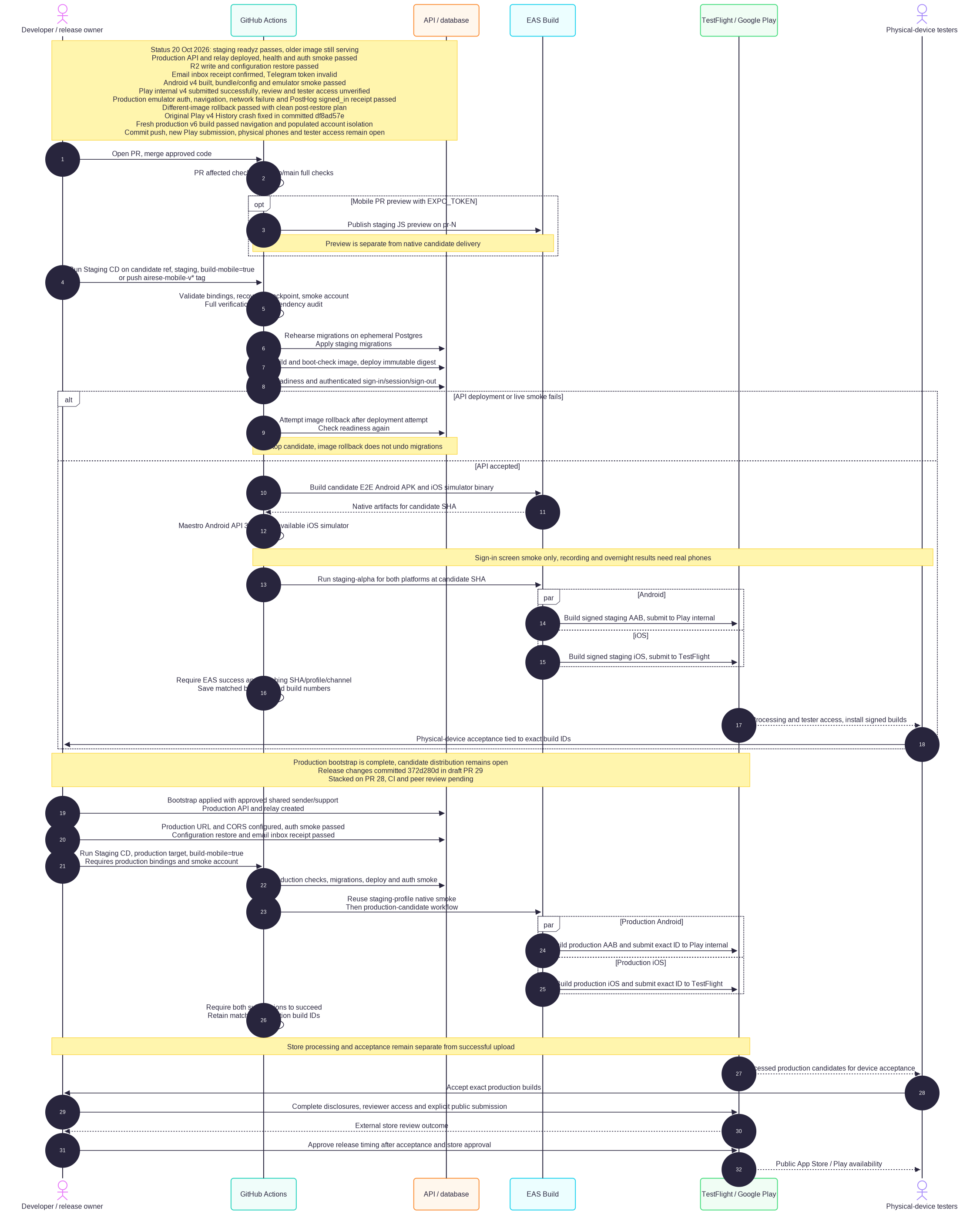
Build automation and release approval are separate steps. The paths below describe the source workflows and the local production submission change; a completed build still needs installation and real-phone evidence.
PR checks: affected format, lint, types, tests, build and secret scan. Develop/main pushes check the full graph.
EAS Update → pr-N preview branch when an Expo token is available. A JS preview is not a signed native build.
Staging CD manual run (build-mobile enabled), or airese-mobile-v* tag → binding and security checks → full verification → migration rehearsal and staging migrations → API deploy and authenticated smoke → Android API 34/35 and iOS simulator smoke → signed staging builds.
EAS staging native build with Apple signing credentials.
Staging App Store Connect app; submission requires Apple and App Store Connect API access.
Confirm Apple processing and tester access, then test the signed candidate on physical iPhones.
EAS staging AAB for store submission. Optional staging-internal APK for sideloading.
Google Play internal testing track; submission requires the EAS-configured Google service account.
Confirm track access, install on supported Android phones and retain overnight evidence.
Verify production routing and signing → production candidate → TestFlight / Play internal upload → physical-device acceptance → store disclosures and reviewer setup → explicit store submission → external review → approved release timing.
Staging CD also accepts a production target with separate bindings. Its production-candidate workflow builds and submits exact production build IDs to TestFlight and Play internal. Store processing, device acceptance, public submission and release remain separate steps. The production Android submit profile targets internal testing, not public release.
Manual and tagged staging candidates deploy and check the API before native smoke and signed mobile delivery. Relevant pushes to staging retain affected-service API deployment without mobile builds; mobile-only pushes do not trigger that path. Running the EAS staging-alpha workflow directly bypasses the GitHub API and smoke gates.
Updated against local source on 19 October 2026 at reverie commit 70eaffee2312b19ebe91df3e745b1deb6a27ab1f plus the uncommitted production submission change: develop-ci, airese-mobile, staging-cd, migration and Lambda workflows; EAS staging-alpha and production-candidate workflows; mobile eas.json. Open the end-to-end sequence diagram and verification notes. The status panel separates verified provider state from the remaining release path. Store readiness and physical-device acceptance remain unverified.
| Capability | November beta proposal | Later phase or open decision |
|---|---|---|
| Setup & consent | Accountless setup, build-specific data disclosures, versioned acceptance, support and local/server data-erasure routes. | Consumer accounts and cross-device restore are outside V1. Server data identification, consent and retention wording remain open. |
| Recording | Phone microphone; setup guidance; overnight capture on approved devices; durable save, stop and interruption handling. | Broader device support after evidence. No wearable prerequisite. |
| Results | Saved nights; explicit pending, complete, incomplete and failed states; approved snoring measurements and versioned interpretation. | Composite score only after methodology approval. Do not label separate measurements as a substitute approved SNOR score. |
| Callback | Result-to-callback CTA, informed sharing, durable user/request join and request confirmation. Test the CCC receipt and failure route. | Zoho Form is the September proposal; destination, response time and CCC owner need approval. Scheduling and downstream care remain separate operational workflows. |
| Measurement & support | Allowlisted funnel events; crashes and reliability telemetry; feedback channel; support triage and pause/rollback decisions. | Thresholds and launch denominators require agreement. Do not infer behavioral funnel proof from the crash-tracking integration. |
| UI and content | Launch-critical screens, readable labels, accessibility basics, compatible text sizes and visible recovery actions. | Mandarin expansion, Explore/editorial expansion and broad navigation redesign after beta evidence, unless Jonas and Gary explicitly retain a tested slice. |
| Commercial and retention | Beta access terms and minimum result history agreed by Gary. | Paid tiers, loyalty, gamification, AI coach, community and advanced trends. |
| Integrations | Only services needed for the accepted recording, result and callback path. | Wearable/SpO₂ expansion, heart-rate signals, clinic referral codes and broader vendor/device-cloud integration. |
| Atenvia | Discovery and a separate referral-to-result contract. | Do not make Airese's November acceptance depend on a live Atenvia release. Confirm shared engineering capacity before committing implementation dates. |
No later-phase date is promised by this PRD. The Notion tracker carries Phase 2 work into February; September's mid-January aspiration requires reconciliation with management.
Design should cover the states below alongside the happy path. Jonas and the designer need to review these against the actual build and Figma source; the June PRD alone does not specify them.
| Screen or state | Required behavior | Review evidence |
|---|---|---|
| Onboarding and permission | Explain why audio is needed before the OS prompt. Denial offers settings/help and a retry. Optional health or BLE permission never blocks microphone-only recording. | First install, denial, later grant and returning-user setup on supported iOS/Android phones. |
| Pre-record check | Show charging, available storage and placement guidance. Explain beta restrictions plainly. Final placement/calibration instructions follow the approved method. | Test low storage, low battery and unavailable microphone. Confirm clear guidance without inventing a universal distance. |
| Recording and stop | Use an unambiguous recording indicator. Prevent duplicate starts/stops. Confirm a destructive action. Show capture gaps and preserve saved data after an interruption. | Screen off, app switching, calls, restart, low storage and repeated stop taps. Check actual capture rather than relying on a timer. |
| Processing and recovery | Show local save and analysis status separately from permitted data submission. Production audio stays local; research submission goes to R2. Offline state explains retry. Returning to the app restores progress without duplicate results. The 8 October phase-1 direction asks users to keep the app open during processing; background completion is deferred. | Network loss, failed upload, delayed analysis and process restart. Never promise a completion time without measured evidence. |
| Morning result | Define each value and its direction. Display uncertainty and insufficient capture. Pair color with text. Missing oxygen data stays missing. Compare nights only when the method permits it. | Valid, incomplete, zero-audio, missing-data and failed-analysis examples; user comprehension review. |
| Callback and return | Explain the destination and shared fields. Ask for consent. Confirm receipt and prevent accidental duplicates. Return from the external form without losing the night. | A synthetic request reaches CCC with the agreed join key. Exercise cancellation, browser failure and retry. |
| Accessibility and wording | Support screen readers, scalable text, sufficient contrast and usable touch targets. Use plain-language labels agreed with the clinical reviewer. Never imply diagnosis or guaranteed accuracy. | EAS-57 accessibility/safety gate and approved copy against the signed candidate. |
“SNOR” is the label in this brief. Historical material uses Sound Score, SnoreScore, Sleep Score and Snore Severity. We need one agreed name and construct before we freeze the result UI.
Notion EAS-83 lists Jonas as delivery owner, Shane as accountable owner, and an elapsed due date of 23 September. EAS-2 depends on this evidence. A replacement date has not been agreed; Shane should obtain it when reviewing this PRD with Jonas.
Fallback proposal if the method misses the beta gate: keep the composite score disabled and show only accepted separate measurements with limitations. Jonas and Gary must explicitly approve any resulting beta scope change.
These proposals follow the 8 October design discussion and independent code/tests review. They are ready for agreement; they do not establish implementation or device acceptance.
Add a terminal recording_failed event after capture starts, separate from start failure and recoverable retries. Count completion when a usable result exists. Use completed onboarding as the activation denominator if phase 1 removes email verification.
Keep the captured night and unfinished work when the app is suspended. Resume one pipeline on reopen. Phase 1 asks the user to keep the app open for results; unattended background completion is deferred.
EAS-21: agree checkpoint/retry cases and the five-minute target. A full backlog may take longer; the target still needs device proof.Confirmed on 13 October: iPhone 15 Plus, Samsung Galaxy A56, Samsung Galaxy S24 Plus and Google Pixel 9 Pro. Record each OS version and candidate build, then schedule physical testing. The proposed iOS 18 and Android 14 floors still need approval; the earlier phone proposal is historical.
EAS-48: availability confirmed; support approval and physical acceptance remain open. Every exact phone/OS/build must pass separately.Use the built-in microphone, agreed placement, charging and required permissions. Keep the app running for capture; the screen may lock. Reopen and keep it open for phase-1 processing. Describe these as planned test phones until acceptance passes.
Independent checks exercise local state, queue and token behavior. They do not prove an overnight result, production analytics payloads or release readiness. Nothing has been sent to Jonas or Gary.
A non-developer installs the signed build, completes accountless setup, records overnight, receives or recovers the result and completes a callback request. Save device, build and test evidence.
Earlier notes proposed five SG devices. The four-phone boundary above is a new proposal; models, markets and capacity need agreement.Scoring and labels are approved. Incomplete or failed recordings are obvious. Privacy, device/data access boundaries, deletion, support and safety-comprehension checks pass.
Agree quantitative battery, capture and repeatability thresholds before acceptance. This draft does not invent them.Verify target routing, signing, deployment, crash diagnostics, backup/restore, alerts and rollback. Name the support and release decision owners.
EAS-65 records the go/no-go; EAS-66 to EAS-68 cover opening the channel, monitoring and the continue/pause decision.Critical recording loss, unauthorised data access, misleading results or an unusable support/callback path block release. Gary and the named clinical/privacy owners should agree the severity policy and exception process with Jonas and Shane.
23 October 2026: Shennan confirmed accountless V1 with staging for testing/pre-production, production audio stored locally with data sent to the database, and research data sent to R2. Exact payloads and access/deletion rules remain open. Earlier account-based proposals below are historical where they conflict.
| Decision or deliverable | Owner and proposed timing | Current position |
|---|---|---|
| Dashboard and PRD layout | Shane with Raena, before Saturday 10 October | Draft prepared; review and marketing material remain open. Saturday interpreted from the 8 October request. |
| November scope, UI handoff and later-phase list | Shane with Jonas, proposed 9 October review; Gary ratifies business boundary | Pending agreement. Confirm effort and capacity against the actual candidate and 11 November target. |
| SNOR methodology delivery date | Jonas delivers; Shane coordinates date and review with Gary/clinical reviewer | Outstanding. No replacement date or approval is recorded. |
| PRD v1 to Gary | Shane sends during 12 to 16 October, after Jonas review | Prepared for next week; not sent or scheduled. If decisions remain open, keep the draft label and state them in the message. |
| Beta callback, cohort and market | Gary approves; Raena aligns marketing; CCC response owner to be confirmed | Destination, SLA, fallback, invite terms and supported markets remain open. |
| Dashboard platform and access | Existing Easmed Vercel deployment; Shane verifies access with Raena | Platform confirmed by Shennan. Notion read/export works in the Fracxional workspace. AUD’NCO account membership is not established by that access. |