
Airese hypotheses, behaviour tracking and heatmaps
Native simulator receipt — 12 November 2026
Version: 2026-11-12-posthog-native-smoke-v1.
The actual PR #43 app, source
d50428a178d358e42cf9c5b6e77f8f984d0fcb3e, built and ran as
version 0.1.13 on the dedicated PR43-PostHog iOS 27 simulator. This was
a development build with a local test API and synthetic account without
the demo-account flag; research upload was disabled. No production app
deployment or physical-device acceptance is implied.
PostHog received first-open, screen, guidance, sign-in, onboarding,
identity-link and device-sample events from the native SDK in the
development environment. Two diagnostic exceptions came from the same
incomplete report fixture. The fixture was repaired and the report then
rendered, with report_viewed received. Neither exception is a controlled
crash or symbolication test. It also received a recording for session
01a1d03b-ce6b-779b-8d7e-3f7c65295c06, beginning at
14:49:05.915 UTC. Direct recording lookup confirmed 48 snapshot events
(about 254 KB) while the recording was still in progress; the replay
list initially lagged behind that receipt. Open
the provider recording.
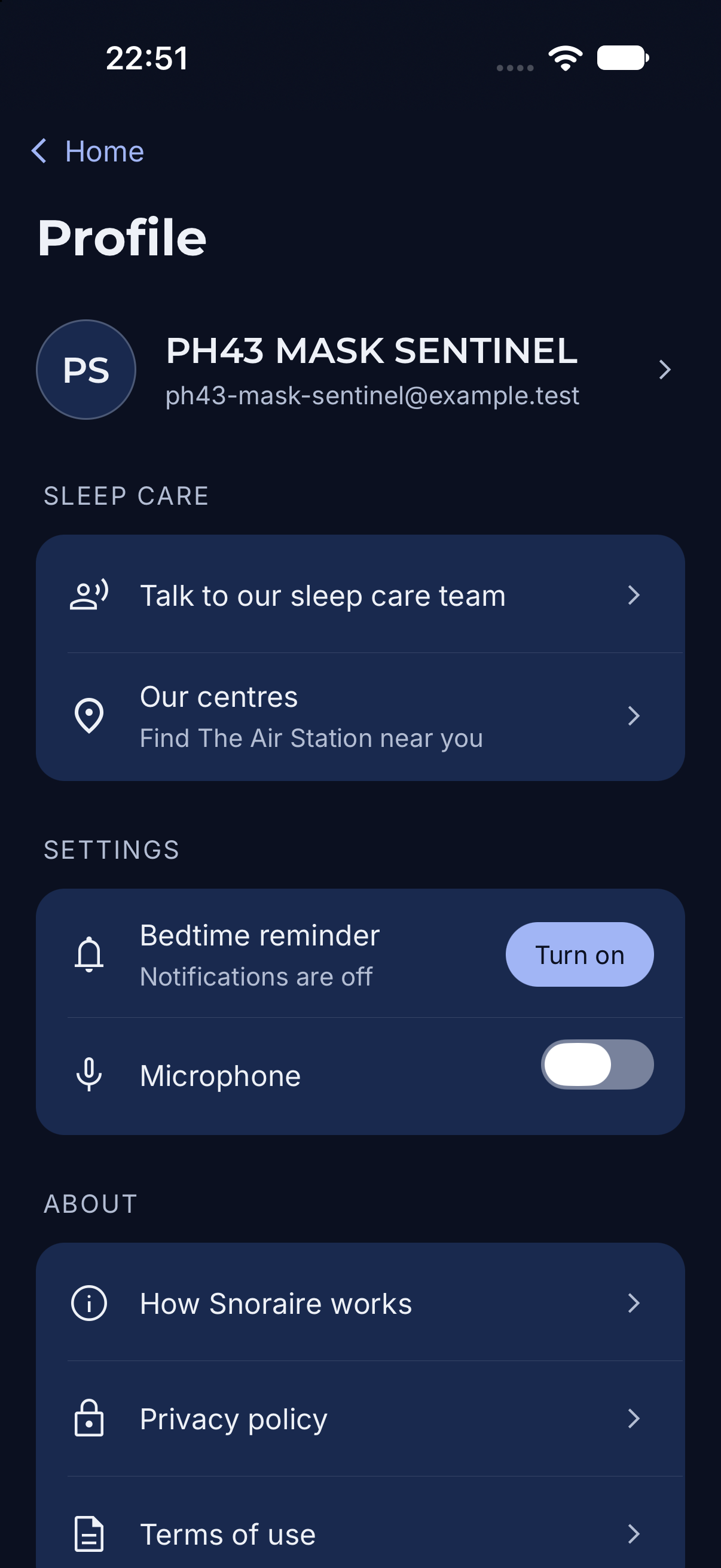
Provider playback showed the Profile identity region black-masked at
03:36 in the first recording. In the
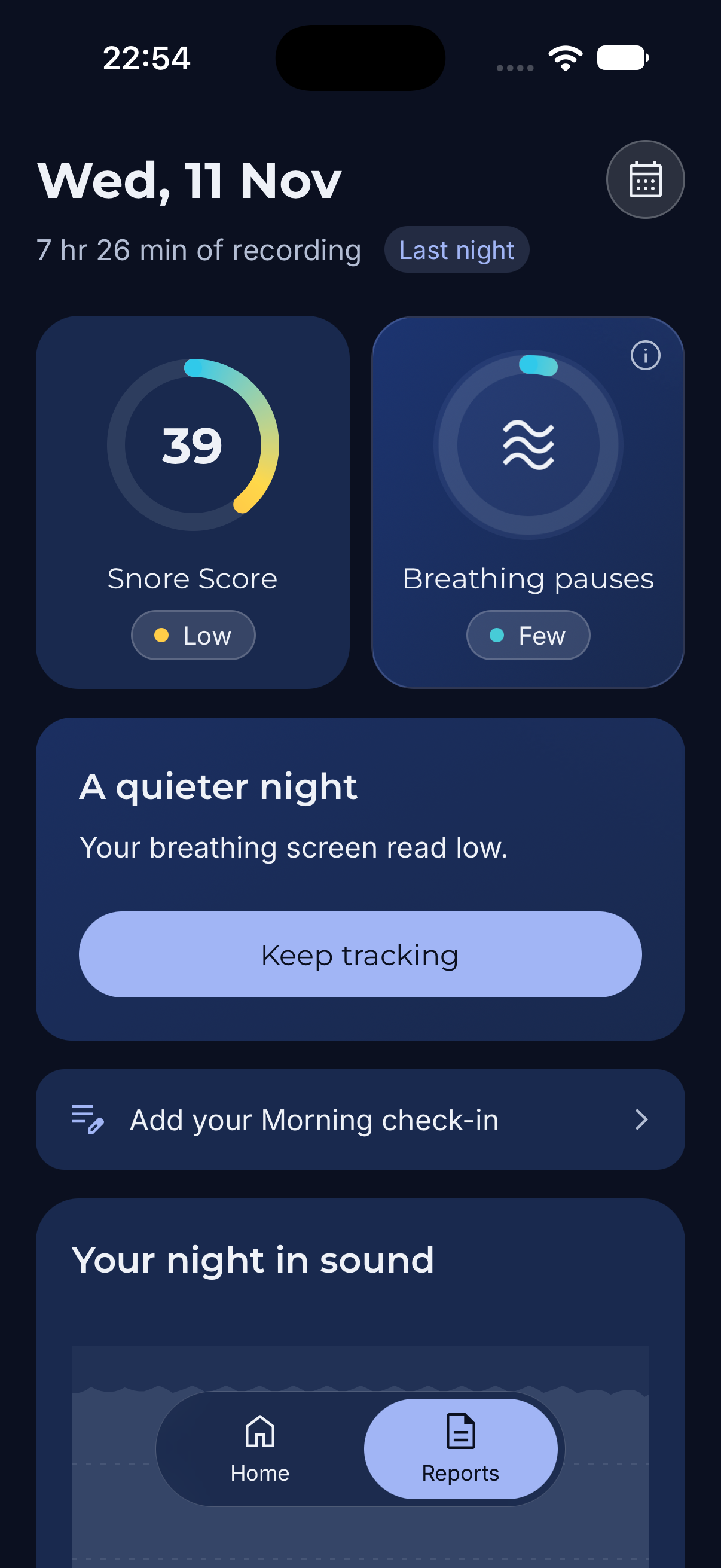
second recording, the Reports frame at 00:15 masked the content
region: the synthetic score, date and duration were unreadable. It also
showed ordinary labels masked on Profile and Guidance. The installed
native SDK treats maskAllTextInputs: true as masking React
Native text generally, including static labels. The current replay
therefore protects text conservatively but does not yet provide readable
static navigation and controls. The earlier synthetic component
screenshots prove layout and interaction, not native replay readability.
No masking setting was weakened during this review.
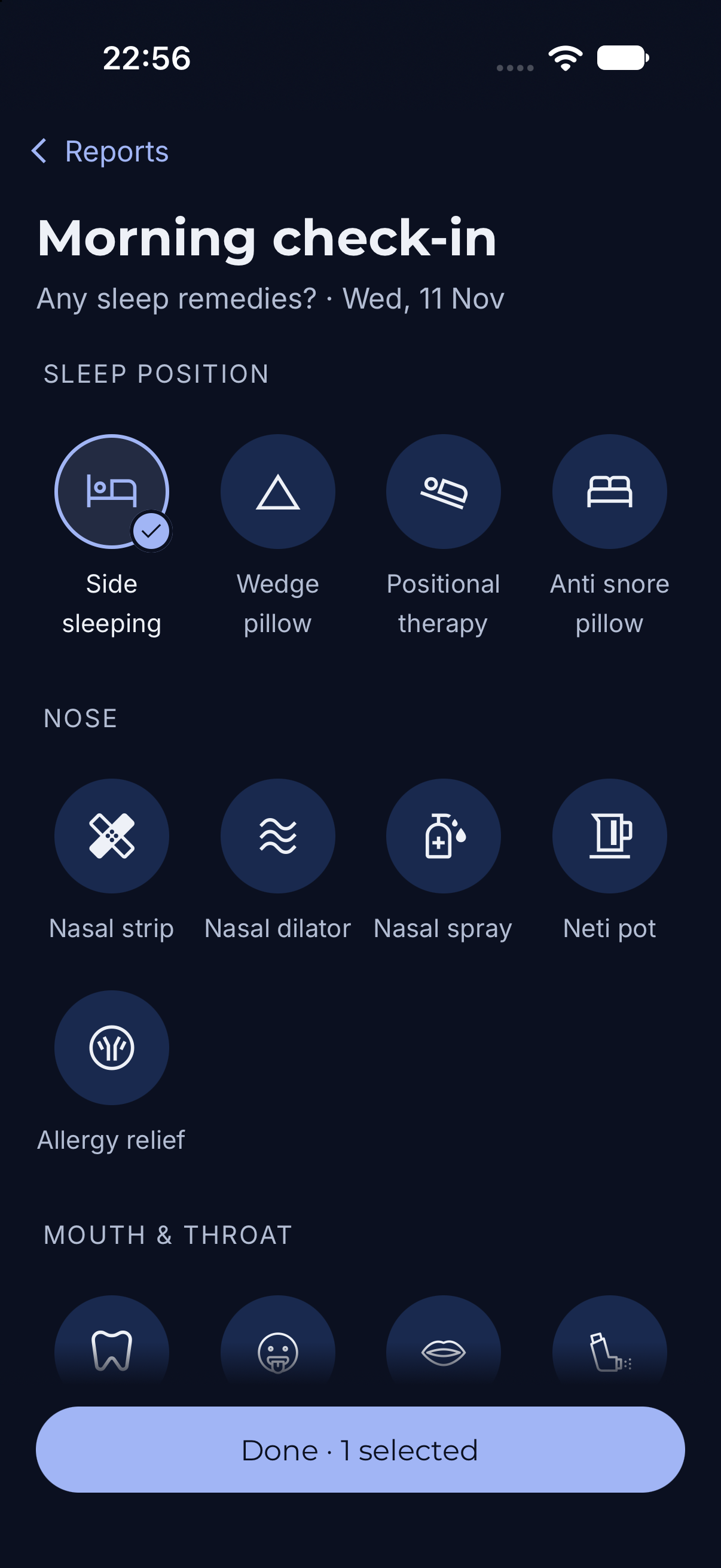
NightNotes is intentionally excluded from replay by the route allowlist; its check_in_saved event was received separately. At 01:59 the second recording showed a NightNotes-labelled, black-covered frame resembling the preceding Reports frame, with Side sleeping unreadable. A frozen prior frame is consistent with paused replay, not evidence of a fresh check-in capture; exact exclusion timing remains unverified. The recording ended at 14:57:19.189 UTC, before the ChangePassword screen event at 14:57:20.705 UTC, consistent with exclusion. Authentication-route exclusion is still only partly checked: the first recording’s SignIn interval showed a masked, frozen-looking frame without raw frame timestamps. The remaining acceptance includes route and modal exclusions, opt-out and account transitions, offline/reconnect and restart behavior, controlled crash/symbolication checks, physical-device metrics and overnight overhead. The simulator receipt does not close those checks, prove comprehension or retention, or establish native spatial heatmaps. Ticket statuses and owners remain unchanged.
The inspected report_viewed and
check_in_saved events contained no score, date, choice,
name or email. Their metadata identified schema version 1, app
0.1.13/build 1, SDK 4.78.2, an emulator and a collection epoch. This
checks those observed events, not every possible payload.
App and provider comparison
These are actual simulator screenshots with synthetic account and report data, not production-user content. They show what the app displayed; the linked provider frames establish what the recording concealed.
| App evidence | Provider evidence and limit |
|---|---|
| Profile screenshot | First recording, 03:36: identity region black-masked. Static labels also masked. |
| Reports screenshot | Second recording, 00:15: report content masked. App fixture showed score 39, Low/Few, Wed 11 Nov and 7 hr 26 min; these were unreadable in the inspected provider frame. |
| Check-in selection screenshot | Second recording, 01:59: masked prior frame consistent with NightNotes being intentionally excluded. check_in_saved was received; exact replay-stop timing remains unverified. |
Flows and recording diagrams
These nine diagrams match PR #43. They show the instrumented journeys and collection rules, not proof that every flow has passed a native test. Events record actions and outcomes, not audio, health values or check-in answers. NightNotes is excluded from replay; its save event contains no answer.
On a narrow screen, scroll each diagram sideways or open the full-size image.
Acquisition and account setup

Onboarding and permissions

Recording and processing

Report and understanding

Check-in and reminders

Care and callback request

Navigation across flows

What data we record

When collection runs or stops

Earlier component screenshots
These three 390 × 1000 React Native Web previews use synthetic data and source from d5469117. They demonstrate component layout and working controls with external requests blocked. They are not native app or captured replay screenshots. The actual native screenshots and provider comparisons appear above.
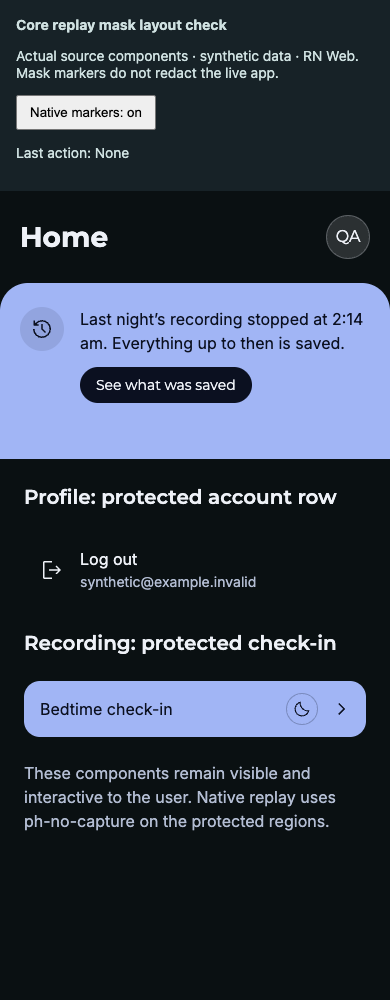
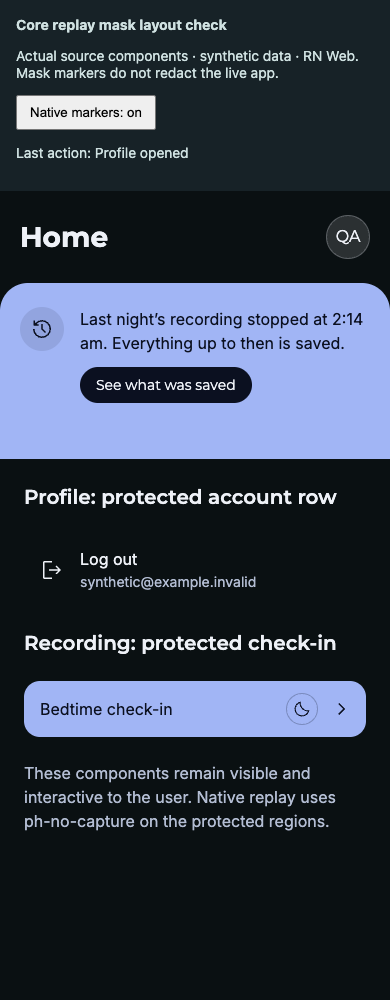
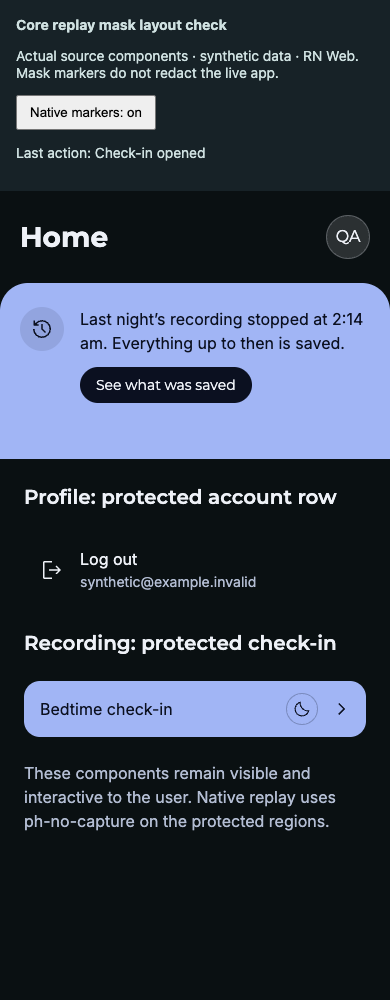
Captured replay frames were inspected in PostHog, but image export did not complete. Use the recording links and timestamps above to inspect those frames; these app and component images are not substitutes for replay images.
Portal cross-check: 12 November 2026
Version: 2026-11-12-posthog-portal-crosscheck-v1.
PR #43 implements seven flows: acquisition and account setup; onboarding and permissions; recording and processing; reports, explanations and playback; check-ins and reminders; care and callback requests; navigation and labelled actions. Its contract contains 32 client events plus server callback acceptance. The PR description includes flow diagrams and three synthetic component screenshots. Those screenshots prove layout and control interaction only; external requests were blocked.
Collection defaults on when no saved choice exists. Saved opt-outs remain off, controls are hidden, and erasure preserves the disabled choice. Replay includes onboarding, Home, Recording, Reports, Profile, Centres and legal routes, with sensitive regions masked. Authentication, password, account-deletion and unlisted routes are excluded from replay; approved screen-label events are a separate path. Redacted exception diagnostics remain separate from product collection. UXCam heatmaps are separate in PR #46.
Coverage and remaining evidence
| Product question | Implemented or prepared | What remains |
|---|---|---|
| Acquisition and setup | First open, campaign attribution, account and onboarding milestones, permission results | Marketing landing-page wiring is deferred. Verify actual install/continuation and account linkage; first open is not a store download. |
| Recording to usable report | Start, failure, stop, processing stages, usable completion and report visit events | Run the actual candidate and match device actions to PostHog records, opaque attempt references and offline/restart deduplication. |
| Report understanding | Explanation and playback events | Agree and run the unaided comprehension task; taps do not establish understanding. |
| Repeat use | Recording events and pseudonymous account linkage | Verify identity continuity and agree eligible users, return window, reinstall rules and denominator before reporting retention. |
| Check-ins, reminders and navigation | Save, schedule/cancel, foreground receipt/open, approved screens and labelled actions | Verify device delivery/open paths and eligible exposure; reminder scheduling does not prove background delivery. |
| Callback and care follow-through | Client success means durable server storage; the delivery path emits server acceptance after a successful Zoho upsert, including background retries | Verify actual request and CRM receipt. Server analytics is best effort, without a telemetry outbox or historical backfill; the delivery row is authoritative. Human response and booking need separate evidence. |
| Reliability and device overhead | Pipeline events/logs, redacted errors, battery/memory/disk samples and iOS MetricKit windows | A recoverable stage failure is not a terminal recording failure; there is no recording_failed event. Verify controlled crashes, readable stacks, device receipt and overnight overhead. |
| Dashboards and alerts | Freshness covers 32 client events plus server acceptance; recording-to-report user funnel is configured | Other funnel views, approved definitions, candidate filters and alert rehearsal remain open. The user funnel may span different recordings and is not a same-attempt completion rate. |
| Replay and native heatmaps | Masked PostHog replay in PR #43; separate UXCam PR #46 | Inspect actual native replay masking and capture transitions. Native spatial heatmaps are not established by PostHog screenshots or tap counts. |
Acceptance before claiming the write works
- Build and run the exact candidate with the matching API and attribution migration deployed in the test environment.
- Use a synthetic test account without the demo-account flag to complete setup, start/stop a recording, view its eligible report, open an explanation and exercise a controlled callback request.
- Read the matching schema-version, build, environment and correlation references back from PostHog. Capture the app action and provider receipt together.
- Check replay exclusions and masking, offline/reconnect, kill/restart, duplicates, saved opt-out, account changes and erasure. Check physical-device metrics and overnight overhead separately.
Current PR head:
d50428a178d358e42cf9c5b6e77f8f984d0fcb3e, integrating
develop 3c5e1567. The final branding and UI-snapshot
integration preserves hidden analytics controls and passed 61 focused
tests. Latest-head
CI records its remote result.
Earlier integration baseline:
7698936efe75307ce2c411c7ec33a5486aaab94a, integrating
develop bebf29c2. The merge conflict is resolved.
Attribution and callback context use migration
0014_product_attribution.sql; existing migrations 0012/0013
are unchanged. Deploy the matching API contract
(collection_policy_version: 4) and migration before the
mobile build. Demo accounts do not emit analytics. Delayed callback
delivery uses the original submission-authorized context; the server
cannot observe later phone withdrawal.
All 15 non-test checks, five builds and release-bundle verification passed. The original full test run had one mobile timeout; the automatic diagnostic rerun passed 7,841 tests with 54 explicit skips. All 15 migrations applied with no schema or applied-file drift. Earlier integration CI passed records the remote result. No app deployment was performed at this integration checkpoint. The later native simulator receipt is recorded above.
Jonas owns instrumentation and dashboard evidence (EAS-35/EAS-110). Shane owns metric agreement and alert readiness (EAS-4/EAS-111); Raena and care owners remain involved in definitions and service outcomes. This cross-check preserves existing owners, ticket statuses and acceptance criteria.
Counterparts: PR #43, portal
coverage, canonical local plan
delivery/docs/airese/airese-behaviour-analytics-implementation-plan-2026-11-03.md,
EAS-4, EAS-35, EAS-110 and EAS-111.
Version: 2026-11-03-analytics-plan-v4 · Research and implementation proposal · 3 November 2026
Portal counterpart: Hypotheses and behaviour analytics, same version. The homepage, Documents index and PRD learning loop link to that view. Portal editing does not synchronize EAS-35/EAS-4 or enable collection.
Replay and attribution draft PR — 6 November 2026
Version: 2026-11-06-replay-attribution-pr-v1. Draft PR #43 is open against develop, from airese/feat/replay-device-attribution, at a4aa5009932658d198724cd67f159587d6e3b9a0. PR #42 has merged; this new PR contains only the subsequent replay, device-metrics and acquisition work. The feature commit was rebased onto develop aa510f3c; conflict resolution preserved the newer onboarding layout, removed both explanatory paragraphs as requested and retained the account-isolation fixes. The worktree is clean and the pushed/PR head matches the local commit.
Fresh validation on the rebased branch passed all 12 pnpm check checks, all five pnpm build targets and six disposable PostgreSQL integration cases. The final documentation-only amendment passed formatting; commit hooks and secret scanning passed. The Android/iOS build results are JavaScript exports, not signed-device acceptance. GitHub readback for this exact SHA found zero workflow runs, check runs or status contexts. Develop CI is configured for develop/main pushes and manual/scheduled runs, not feature branches or PRs; no upstream CI pass is claimed.
Marketing will configure Fathom later, so live landing-page wiring remains deferred. The browser adapter is prepared. No production migration, deployment, store-install/provider receipt or native acceptance is claimed. Owners, statuses and acceptance criteria remain unchanged. Earlier statements that these edits are uncommitted or belong only to PR #42 are historical and superseded by this handoff.
Evidence: outputs/airese-metrics-verification-2026-11-06/pr-43/. Canonical implementation plan: delivery/docs/airese/airese-behaviour-analytics-implementation-plan-2026-11-03.md. Related: EAS-4, EAS-35, EAS-110 and the Marketing-to-Care journey plan.
Campaign attribution and account lifecycle — 6 November 2026
Version: 2026-11-06-acquisition-v1. The user authorized implementing the landing-page-to-product lifecycle after confirming Marketing uses Fathom. This is the current implementation direction; earlier attribution deferrals and no-identify statements below are historical. This does not change existing release dates or establish beta acceptance.
Local source in repos/reverie-worktrees/airese-feat-story-tracking now includes:
- A Fathom download-button adapter that sends fixed
download_ios/download_androidevents, requests a bounded campaign handoff and preserves the original validated store destination when attribution fails. Its standalone browser module is about 2 KB. The actual landing page has not been connected because its URL/repository and published store destinations have not been supplied. - A seven-day, one-claimant handoff stored as a token hash. The same claimant can retry a lost response. Android’s Play referrer carries the opaque token only; Expo Application reads it after opt-in. iOS uses aggregate App Store campaign parameters plus a separate, explicitly opened
airese://attribution?token=…continuation. Automatic iOS post-install attribution and verified Universal Links are not claimed. - Authenticated account attachment to a random backend-issued analytics UUID. This UUID, not an auth ID, email or phone, is passed to PostHog identify. The first sign-in preserves anonymous onboarding events for the join. Logout/different-account behavior still disables collection, clears queued optional usage and acquisition credentials, stops replay and resets identity; delayed work rechecks account and collection epoch. Consent version 3 requires a fresh choice.
- A 32-event client allowlist: the prior 30 plus
app_first_open_observedandacquisition_attributed. The first-open observation is queued once when collection can run, with delay from the first local launch of this instrumentation. It is not a download count, is not backdated, and can first occur on an existing installation after an update. Local launch/sent flags survive withdrawal/account switches; full local erasure starts a new measurement window. - Validated first-touch campaign labels and opaque journey references on subsequent optional app events. The backend preserves the account’s first received campaign across later campaigns/devices. Fathom remains campaign-level website reporting, not a person-identity source. Handoff possession establishes journey continuity, not proof that a website visitor and app holder are the same person.
Migration 0005_product_attribution.sql adds acquisition_handoffs and product_analytics_accounts, with account-deletion cascades and opportunistic expired-handoff cleanup. Seven days is the implemented handoff expiry, not an agreed multi-touch campaign-credit window. The API uses its existing origin configuration and an isolated, shared PostgreSQL rate-limit budget. No production migration, environment-value change or deployment was performed.
Validation: all 12 pnpm check checks and all five pnpm build targets passed. Android/iOS builds here are JavaScript exports. Six additional integration cases ran against a disposable loopback PostgreSQL 17 database: migration application against a minimal users fixture; browser-helper → HTTP mint → referrer token → HTTP claim → account attachment; concurrent claim winner/idempotent retry; expiry; cross-account protection; immutable first touch; and deletion cascades. The container was removed after verification. These tests use a stubbed authenticated session and do not establish actual store delivery or provider receipt.
The existing draft PR #42 remains at f73588e6956aa4dd81cc38c47d63474c9017fb7c; this slice is uncommitted and not pushed. It does not add a Zoho Journey module, human callback response, booking reconciliation or new saved PostHog dashboards. The existing callback acceptance event continues to use the consented PostHog UUID headers.
Remaining integration inputs are the real landing-page URL/repository, matching API environment and allowed origin, campaign taxonomy, published iOS/Android store URLs and Apple’s generated provider token. Then wire the real buttons and iOS return link, deploy the migration/API through the normal release process, install signed candidates and verify both store paths, consent/withdrawal, account switches/reinstall and linked PostHog receipt. Existing native masking and overnight-overhead acceptance remain open. No ticket was closed or owner/date/status/acceptance property changed.
Canonical local plan: delivery/docs/airese/airese-behaviour-analytics-implementation-plan-2026-11-03.md. Implementation recipe: docs/recipes/marketing-attribution.md in the Airese worktree. Review evidence and browser module: outputs/airese-metrics-verification-2026-11-06/acquisition/.
Related: EAS-4, EAS-35, EAS-110, Marketing-to-Care journey plan, existing draft PR #42.
Historical replay and device-metrics checkpoint — 6 November 2026
Version: 2026-11-06-replay-device-v1. The user authorized enabling native PostHog replay and sending device metrics, then requested removal of both explanatory paragraphs from the analytics setting. This is the current scope; earlier replay-off statements below are historical.
Implementation is local in repos/reverie-worktrees/airese-feat-story-tracking, on airese/feat/story-tracking. The setting now shows the switch and save-error feedback only. Optional collection defaults off. Consent version 2 requires a fresh choice because the earlier wording explicitly excluded screen recording.
Replay starts manually after SDK readiness, current consent and foreground route eligibility. Starts/stops are serialized; backgrounding, withdrawal, account change and unmount stop capture. The eligible screens are welcome, analytics choice, walkthrough, microphone/notification permission, centres and legal. Home, reports, recording, notes, account/profile details and unknown/debug screens are excluded and additionally masked at the native root while stop crosses the bridge. Text, images and sandboxed views are masked. Touch coordinates, console capture and network telemetry are disabled. Snapshot throttle: two seconds. No additional SDK or overnight replay timer was added.
Two events extend the client allowlist from 28 to 30. device_metrics_sampled reports available battery percentage, charging/low-power state, free disk MiB and process memory MiB, with app/build/OS/device model/manufacturer metadata. Samples run on foreground entry and recording start/stop, and at most once per five minutes on the existing recording pulse, including background recording. In-flight reads are discarded across consent/account epochs. Unknown or invalid sensors are omitted rather than converted to zero.
device_metrics_window reports delayed iOS MetricKit CPU, foreground/background/background-audio seconds, peak/suspended memory MiB and logical writes MiB. Window duration and age use hours. Only windows beginning after the current choice and belonging entirely to the current app version qualify. Bounds are local deduplication keys; stable persisted event UUIDs protect retries. These are OS accounting windows, not live CPU measurements or individual-night costs. Android has no equivalent CPU/window collector in this slice.
Usage events/logs retain send-time consent/epoch filtering. Native replay has a separate upload queue: stopping prevents new capture but does not promise purging previously collected native replay batches or provider-held data. Provider erasure remains separate. The live project replay setting was already on with 30-day retention; no provider settings, saved dashboards, alerts or retention were changed.
Validation: all 12 pnpm check checks passed and all five pnpm build projects passed, including Android/iOS JavaScript exports. The four focused analytics test files passed 23 cases. These checks do not build or exercise a native phone binary. Rendered app acceptance remains unverified.
The existing draft PR #42 still points to f73588e6956aa4dd81cc38c47d63474c9017fb7c; this new slice is uncommitted and has not been pushed or deployed. The repository’s CLAUDE.md requires an explicit commit/push instruction in the current turn. GitHub PR/CI status from the earlier handoff does not validate these edits.
Acceptance remains open for Android/iOS replay frames, sensitive-route/navigation/modal masking, foreground/background and offline withdrawal/relaunch, shared-device account changes, unavailable modules/sensors, linked provider receipt and overnight battery/memory overhead. No Android device was attached and no iOS simulator was booted at this checkpoint. The saved dashboard has not yet been extended to these events. No ticket was closed and owners, dates, statuses and existing acceptance criteria remain unchanged.
Canonical implementation: apps/airese-mobile/docs/architecture/client-telemetry.md in the Airese worktree. Review evidence: outputs/airese-metrics-verification-2026-11-06/replay-device/. Related tickets: EAS-4, EAS-35, EAS-110. Existing draft PR #42.
Draft PR handoff — 6 November 2026
Version: 2026-11-06-story-tracking-pr-v1. Draft PR #42 targets develop from airese/feat/story-tracking. The reviewed and pushed head is f73588e6956aa4dd81cc38c47d63474c9017fb7c. Commit hooks passed without changing the validated source hashes; the worktree is clean.
Local validation remains 12/12 checks and 5/5 builds passed. GitHub readback for this exact head found no workflow runs, check runs or status contexts. Develop CI is configured for pushes to develop/main, scheduled audits and manual dispatch, not feature branches or PRs; no remote CI pass is claimed. The PR is draft and open, not merged or deployed. Phone/provider receipt and optional server configuration remain pending.
Evidence: outputs/airese-metrics-verification-2026-11-06/implementation/draft-pr-receipt.json. The implementation notes below retain their original date; their “uncommitted/no push” sentence is historical and superseded by this handoff. Owners, ticket statuses and acceptance criteria are unchanged.
Story-tracking implementation — 6 November 2026
Version: 2026-11-06-story-tracking-implementation-v1. The user authorized implementing the required PostHog integrations in Airese and creating a separate worktree. This section supersedes earlier statements that all new tracking exists only on the older analytics branch.
The isolated branch airese/feat/story-tracking is based on upstream develop f0aaf328 (mobile 0.1.10), at repos/reverie-worktrees/airese-feat-story-tracking. It reuses the existing SDK and earlier event/privacy helpers without copying unrelated CI or UXCam work from the primary checkout. Changes remain uncommitted; no push, deployment, collection-setting change, CRM test write or email was performed.
Implemented coverage
- A 28-event client allowlist covers account sign-in/setup outcomes, setup/permission milestones, foreground screens and selected controls, recording start/stop/usable completion, matching ready-report views, explanations and care exposure, request attempts/client outcomes, playback start/failure, persisted check-in saves, reminder scheduling/cancellation and running-app receipt/open callbacks, plus pipeline stages.
- The API owns a separate
callback_request_acceptedevent after the existing service receives a successful Zoho upsert. It uses validated anonymous UUID headers and fixed metadata only.request_action=updateis not a new lead. Client success and server acceptance remain different observations; a timeout may occur after acceptance. - Optional usage tracking defaults off, with onboarding and Profile choices. Fixed labels and random request/attempt/visit references exclude notes, ratings, audio, contact details, health values and raw paths. Withdrawal filters queued usage at transport time. Erase everything disables usage first and overwrites its local preference store.
- Account IDs remain local. Anonymous identity/correlation resets across account boundaries; logout or another account disables usage so that consent is not inherited. The first sign-in may retain the choice explicitly made on that install. No cross-login/account identity join is approved or implemented.
- The existing recorder, account/password rules, callback payload and care service behavior are preserved. Callback telemetry is bounded to 750ms and cannot turn service success into an error.
Configuration, evidence and remaining limits
The app uses its existing PostHog public-token/host configuration. Server collection stays off until optional environment-scoped TF_POSTHOG_PROJECT_TOKEN and TF_POSTHOG_HOST are populated and deployed. Terraform, workflow bindings, example configuration and the staging routing manifest are included. No production values were read or set.
The full client event definitions and counting boundaries are documented in the worktree’s apps/airese-mobile/docs/architecture/client-telemetry.md. Fresh validation receipts are retained under outputs/airese-metrics-verification-2026-11-06/implementation/. The model asset used for the build was regenerated with the existing repository metadata-removal script from the cached model; the output exactly matches the current pinned SHA-256, with a byte-identical inference graph.
This is local implementation/build evidence. Physical-phone/provider receipt, native withdrawal/offline behavior, consent-screen visual acceptance, controlled crashes and overnight overhead remain open. Reminder callbacks do not establish background delivery or cold-launch opens; playback start does not prove a whole clip was heard. Human care response, independent comprehension assessment, support-inbox receipt and cross-account retention remain separate work. The saved freshness dashboard still covers the older 13-event set and was not changed here.
EAS-4/EAS-35/EAS-110 carry this shared implementation version; existing owners, dates, acceptance criteria and statuses are preserved. Metric targets, denominators, time windows, cohort exclusions and collection-policy agreement remain open. Earlier crosswalk/draft statements below describe the pre-implementation state.
Final local validation: pnpm check passed all 12 checks and pnpm build passed all five projects. An earlier password-reset timing test failed under concurrent load; the complete API suite and subsequent full workspace check passed without changing that test. Fresh receipts and source hashes are retained in the implementation evidence folder. Physical-device/provider receipt and rendered UI acceptance remain unverified.
Historical user-story coverage review — 6 November 2026
Version: 2026-11-06-story-tracking-review-v1. FR-01–FR-16 and the PRD success measures were checked against the local 15-event contract and the live receipt checkpoint above. These are story summaries derived from requirements, not newly approved stories. D-01’s password-based sign-in and D-28/D-29’s MVP inclusion of check-ins/reminders supersede conflicting older PRD wording.
Local coverage includes setup/permission outcomes, starts/stops, usable completion, ready-report views, selected history controls, explanation opens and care-interest taps. None has verified schema-v1 provider receipt. Gaps include current account-lifecycle integration, explicit playback and Night Notes/check-in success, reminder configuration/delivery, callback acceptance/CRM receipt/human response and an agreed care-exposure denominator. Repeat use needs identity/night grouping and a full return window; comprehension needs an unaided usability task. Privacy/deletion, support and overnight reliability need authoritative acceptance evidence alongside optional product events.
The proposed review with Raena prioritizes activation, usable report, comprehension, repeat use and care handoff, then agrees whether playback/check-in/reminder outcomes need additional minimal tracking. No new event, target, scope, owner assignment or deadline is approved by this review.
Full crosswalk: outputs/airese-metrics-verification-2026-11-06/user-story-tracking-review.md. Draft: outputs/airese-metrics-verification-2026-11-06/raena-user-stories-metrics-draft.md. Canonical plan: delivery/docs/airese/airese-behaviour-analytics-implementation-plan-2026-11-03.md. Related: EAS-4 (definitions), EAS-35 (implementation), EAS-110 (dashboards). No email sent; existing acceptance criteria and ticket statuses are preserved.
Verified metrics checkpoint — 6 November 2026
Version: 2026-11-06-metrics-verification-v1. Checked against live PostHog, current upstream source, the local working tree and Notion. This section supersedes older coverage and access claims below; metric proposals and acceptance criteria remain open.
What we can currently report
The metrics proposal was sent to Raena on 5 November at 09:12 SGT from hello@fracxional.com. A fresh search of that mailbox found the sent message and no matching reply; receipt, agreement and any response through shane@audnco.com or Teams are unverified.
Live PostHog project 627573 still has seven saved dashboard tiles: five wizard views and two drafts (stop reason and event freshness). The email’s statement that additions were not saved is superseded by this readback. The freshness draft covers 13 events and omits the later onboarding_completed and permission_result additions; the local contract permits 15 events. The old activation funnel still expects signed_in → email_verified → onboarding_completed → microphone_permission_granted → recording_started and is not an accepted definition of the current journey.
The rolling 30-day inventory checked around 23:49 UTC on 5 November (07:49 SGT on 6 November) contains 24 recording starts, 20 stops, five historical onboarding completions and 64 exceptions. Latest start: 1 November 17:12 UTC; stop: 1 November 20:47 UTC; onboarding: 20 October 04:31 UTC; exception: 21 October 08:32 UTC. These are mixed historical/test diagnostic counts, not people, usable-completion rates or conversion. All three product-event groups have no schema_version value. No schema-v1 contract receipt was observed. Lifecycle events continued into 5 November, which does not establish receipt of the new tracking.
There are no configured log alerts. General analytics/error-alert configuration could not be inspected because alert:read and hog_function:read are unavailable. The approved metric catalog is also inaccessible (data_catalog:read); no absence of approved definitions is inferred. No alert was activated or tested.
Source, build and service boundaries
The analytics working tree is still based on Reverie 653cf470 with uncommitted tracking and UXCam changes. Fresh pnpm check passed 12/12 checks and pnpm build passed all five projects. These validate this local tree only.
Current upstream develop is f0aaf328, mobile version 0.1.10. Its Reports code calls requestCareTeamCallback, which posts to /api/v1/care-team/callback-requests; the API contains the matching route and tests. The earlier “callback is a placeholder” statement applies to the older analytics working tree, not current upstream. The new product-event contract and heatmap helper are absent from upstream, and source search found none of the new completion/report/care-acceptance events there. We need to integrate analytics into the current app before claiming candidate coverage. No merge, deployment or production callback/CRM write was verified.
The 5 November Android APK and replacement iOS simulator artifact receipts remain historical native-build evidence. UXCam collection is disabled; physical-phone masking, withdrawal, heatmap receipt, controlled crashes and overnight overhead are unaccepted. The fresh device inventory has no attached Android phone and only shutdown iOS simulators. No device acceptance test was possible.
What we need to agree and prove next
- Shane owns metric definition agreement (EAS-4): with Raena, agree the questions, audience, targets, counting units, denominators, observation/return windows and test-traffic exclusions. Result comprehension needs a usability task; clicks alone cannot establish understanding.
- Jonas owns instrumentation and dashboards (EAS-35/EAS-110): reconcile the local 15-event contract with current upstream authentication and callback paths; verify the exact Android/iOS candidate, privacy controls and PostHog receipt. Then update the activation funnel and freshness coverage, and add the recording → usable completion → matching report views.
- Care acceptance, CRM receipt and first human response need separate service evidence and permitted opaque correlation. Repeat-use reporting needs verified identity continuity. Neither is inferred from historical starts or CTA taps.
- Shane owns alert readiness (EAS-111): agree thresholds and primary/backup responders after receipt/baseline evidence, then rehearse one alert and a continue/pause/rollback decision. No rehearsal is recorded as complete.
Notion access works in this pass. The checkpoint is reconciled manually with EAS-4, EAS-35, EAS-110 and EAS-111; their existing owners, statuses, dates and acceptance criteria are preserved. Earlier authentication failures and five-tile/UXCam-unimplemented claims below are historical. Generated dashboard snapshots are unchanged.
Counterparts: EAS-4, EAS-35, EAS-110, EAS-111. PostHog dashboard. Fresh evidence: outputs/airese-metrics-verification-2026-11-06/. The analytics portal is a local review copy; no publication or email was sent in this pass. Saved ticket text was read back and checked against the local checkpoint; owners, dates, statuses and acceptance criteria match their pre-edit values. Portal content/section checks passed. Rendered Notion and portal layout review was attempted but blocked by the unavailable browser access host.
Historical coverage and validation: 5 November 2026
Checkpoint: 2026-11-05-analytics-coverage-v3. This section supersedes the historical execution status below; the measurement proposals and open decisions remain unchanged.
We do not yet have complete beta measurement. The current checkout passes its local checks, but the new behaviour events have not been verified in PostHog. The table covers the PRD success measures as well as behaviour, crashes and heatmaps.
| Measure | Status | Evidence | Required next step |
|---|---|---|---|
| Setup to first recording | Local code; receipt pending | The optional contract now permits onboarding_completed and permission_result. Completion follows the saved first-run flag; permission outcomes use system readback after a request. No candidate receipt is verified. | Verify setup completion, granted/refused permission outcomes and first recording on the candidate. The historical verification-first funnel still needs revision. |
| Usable recording and report | Local code; receipt pending | Count-once start, stop, usable completion and matching report events are implemented locally. No new completion/report events were found in the last 30 days. | Verify attempt references, offline/restart deduplication and the existing two-hour eligibility rule on Android and iPhone. |
| Repeat recording | Definition pending | Starts can support repeat-use analysis, but installation/account continuity and the return window are unresolved. | Agree identity, full observation window and treatment of reinstalls before reporting a rate. |
| Screen paths and control usage | Local code; receipt pending | Static screen names and labelled actions are implemented. No $screen or ui_interacted receipt was found in the last 30 days. | Run scripted foreground, tab, sheet and return journeys; reconcile events with actual actions. |
| Report explanation and next step | Local code; receipt pending | Ready-report views, explanations and care-interest taps are implemented. Their new events have no observed receipt. | Verify visit references and eligible exposures. A care-interest tap does not establish a submitted request. |
| Result comprehension | Usability task required | The PRD proposes an unaided explanation task. Navigation events cannot measure understanding. | Agree the rubric, participants, reviewer and threshold; record task results alongside behavioural evidence. |
| Callback requests and care follow-through | Blocked by service path | The app currently exposes a placeholder care action. Accepted requests, correct-team receipt and first human response are not established. | Implement the real request path and join service outcomes with an opaque request reference. |
| Crashes and exceptions | Historical ingestion; crash test pending | PostHog received $exception, most recently 21 October UTC. The replacement iOS simulator binary has matching uploaded native symbol files. Controlled crash receipt remains unverified. | Prove JS/native crash receipt and readable stacks for the exact Android/iOS candidate; review the native privacy path. |
| Pipeline and recording reliability | Partial | Pipeline stage events/logs exist locally. Stop-reason and freshness draft views are saved; candidate events are absent. | Prove terminal failures, processing time and build/device breakdowns; agree denominators and alert owners. |
| Battery, memory and overnight termination | Device evidence required | Product events and crash capture do not establish battery drain, memory behaviour or OS termination rates. | Run the physical-phone overnight matrix with analytics off/on and record device/build measurements. |
| Native spatial heatmaps | Native builds passed; pilot pending | UXCam 6.0.25 is included in completed Android APK and iOS simulator builds. Collection is off; no live heatmap receipt is verified. | Configure the Easmed project and synthetic pilot build. Verify masking, coordinates, withdrawal and overnight overhead on physical phones before broadening beta coverage. |
Verified this pass
- PostHog project 627573 has seven tiles on the wizard dashboard: the original five plus draft stop-reason and new-event freshness views. Both drafts show no matching candidate data. Dashboard. No new view was saved in this pass.
- The 30-day event inventory includes historical recording starts/stops and exceptions, but no screen, control, usable-completion, report, explanation, care-interest or pipeline contract events. Recent application lifecycle events are not proof of the new contract.
pnpm checkpassed all 12 checks;pnpm buildpassed all five projects. The focused onboarding/permission/contract run passed 17 tests across three files. These checks validate the local checkout, not a signed or deployed candidate.- Android inventory contains no attached device. iOS inventory contains shutdown simulators only. Physical-device receipt, exact-build symbolication, masking and overnight overhead remain untested.
- The PostHog connector exposes read operations for dashboards/insights. The existing Comet session displays the saved dashboard, but concurrent browser activity prevented a reliable editing session. Chrome requires PostHog sign-in.
- Notion fetches for EAS-35, EAS-110 and EAS-111 returned “MCP authentication required.” Those ticket checkpoint notes remain unsynced. Their owners, acceptance criteria and statuses were not changed.
Evidence: local validation receipt. The live approved metric catalog could not be inspected with the current connection scopes, so no rate is labelled canonical or approved. Targets, denominators and observation windows still require agreement.
Setup milestone implementation: 5 November 2026
The optional contract now includes onboarding_completed and permission_result, bringing the permitted product event set to 15. Completion is emitted after the first-run flag is saved and is suppressed for repeated completion callbacks and demo builds. Clearing local onboarding state permits a later completion; it does not establish a new person. There is no backfill for setup completed while usage analytics was off.
permission_result carries only permission_kind (microphone or notifications) and permission_status (granted, ask or blocked). It follows a successful system read after an explicit permission request, including a refusal or a prompt failure followed by successful readback. Foreground refreshes and failed reads emit no response. Permission changes made directly in Settings are not request-response events. The existing optional collection gate, epoch filter and withdrawal behaviour cover both new events. No form fields or native error strings are included.
New regression tests cover completion deduplication, fixed permission labels, grant/refusal readback, prompt failure, failed reads, foreground refreshes and analytics failure during a permission request. The full workspace check and build were rerun after this change. The provider’s saved freshness view still covers the earlier 13-event set and needs the two new names added when provider editing is available.
The dedicated iPhone simulator booted and the installed development client launched. Metro started on port 19000, but the computer-use connector could not open Simulator (Invalid app for both bundle ID and Xcode app path). The current source was not observed running in that client, so this is not a runtime or receipt pass. No phone state was erased.
The earlier vendor review inspected UXCam package 6.0.26. The current local pilot pins the older 6.0.25 release and leaves the repository minimum-release-age policy unchanged. The SDK defaults to opting users into session recording; the integration therefore requires a separate explicit choice and masked startup. No UXCam account or app key was configured, and no live collection was enabled. The Easmed-owned project remains unresolved. Integration, masking, opt-out.
Notion synchronization remains blocked by the authentication response recorded above. EAS-35/EAS-4 need the two event definitions and acceptance notes; EAS-110 needs the saved-view coverage update. Existing ticket statuses remain unchanged.
Native heatmap integration: 5 November 2026
The working tree now includes a UXCam pilot. Both APP_HEATMAP_PILOT=1 and EXPO_PUBLIC_UXCAM_APP_KEY are required, followed by a separate default-off choice in onboarding or Profile. Ordinary release profiles leave the capability off. An old binary without the native module/privacy view fails closed. The native dependency changes the fingerprint, so it needs a new binary.
The initial spatial scope is Welcome, Guidance and Legal. The inspected content on these screens is static. Other scenes use an overlay with hidden gestures and a fixed Excluded tag; protected stack scenes also have a native occlusion wrapper. Text inputs are masked at SDK startup. The code passes no account identifiers, contact fields, results, notes or custom events to UXCam. The provider still receives device/session metadata and network requests, which need payload and processing review.
The implementation delays SDK loading/start until opt-in, rejects stale start/route requests, and requests native opt-out and pending-upload deletion on withdrawal. Pending deletion waits for SDK verification; a late verification after withdrawal requests cleanup again. Local erasure includes the heatmap-choice store and still clears other preference stores if native opt-out fails, reporting that failed step. Native withdrawal and offline queue behaviour remain unaccepted.
The SDK’s crash handler is disabled so PostHog retains crash ownership. Native masking and dashboard privacy overrides must be reviewed together. The new tests check collection gates, fixed labels, masking configuration, the exact masking-scope key in both installed native implementations, asynchronous withdrawal/route races and storage failure. Android and iOS autolinking identify UXCam 6.0.25. The Android SDK wrapper compiled with :react-native-ux-cam:compileDebugJavaWithJavac. The iOS SDK sources compiled, but the complete local Release build stopped at PostHog symbol upload because local CLI credentials are absent. Earlier disk-space and stale generated-font failures were resolved without changing tracked product requirements. Neither result proves a full installed candidate or native privacy/performance acceptance.
EAS access is verified as shane-easmed, with Admin access to the-air-station; the selected project is @the-air-station/airese (10f790c2-8111-4223-b225-fe51d6229720). The project-level preview and production environments contain the PostHog CLI key/project/host and public SDK variable names. Their secret values were not requested. Development has none of those names. No environment has the UXCam key or pilot-flag name. Local credential absence does not establish a cloud credential problem; validity still requires a successful upload.
The existing e2e-test profile is internal, uses preview and produces an Android APK and iOS simulator build. EAS CLI 27.1.0 satisfies the current minimum; the older 24.12.0 executable was rejected. The source archive was inspected before upload: current tracking files and lockfile match, and checked credential filenames are absent. The builds use an uncommitted local snapshot, not a claim that these changes are in the recorded base Git SHA. No credential was changed and no store submission was requested. Archive receipt, build status.
Internal builds completed: Android APK and replacement iOS simulator app. Both identify as staging version 0.1.8; Android is versionCode 22 and iOS is build 1. They are internal verification artifacts, not Play Store or TestFlight distribution links. The iOS-only correction was built after the first pair; these are not a matched final release candidate.
Artifact inspection confirms the Android SDK module, privacy-view manager and registration name, and all three iOS native privacy classes. Both packaged configurations keep the pilot flag false and omit the UXCam key. The first iOS artifact omitted the vendor’s DiskSpace reason 7D9E.1 from the aggregate manifest. Explicit Expo ios.privacyManifests configuration fixes this: the replacement artifact contains every API reason declared by the pinned SDK. This mechanical comparison does not establish store privacy approval. Android artifact receipt, replacement iOS receipt, replacement source hashes.
PostHog has uploaded symbol files matching both replacement iOS binary UUIDs, with no reported parsing failure. That is exact-artifact upload evidence, not a readable controlled crash. Historical release metadata is excluded from the receipt; it does not prove the current uncommitted source. Symbol receipt. Full local checks (12/12), builds (5/5) and 11 heatmap tests passed after the privacy fix.
The physical QA rig was checked directly: Android reported no attached adb device, and CoreDevice could not find the documented iPhone target. The wrapper’s empty recording status was not treated as proof that a phone was idle. No capture was started and no device data was erased. Phone-based event receipt, controlled JS/native crashes, privacy sentinels, withdrawal and overnight performance remain open.
PostHog exception ingestion is enabled, with no configured project or per-issue rate-limit values. The fresh provider inventory still contains no screen/control/completion/report/explanation/care-interest/pipeline receipt for the new contract. Browser editing was retried: the native Comet target returned cgWindowNotFound, and inventory reports the browser host unavailable. No view or alert was saved. Notion again returned MCP authentication required, so EAS-35/EAS-4/EAS-110/EAS-111 remain unsynced with this checkpoint. Existing owners and statuses are unchanged.
The current portal table matches all 11 canonical rows and the saved receipt. Final visual review remains blocked: Chrome native controls respond, but reload and a fresh query-string navigation render blank while the local endpoint returns HTTP 200. The updated view has not been published.
This is preparation for the agreed synthetic pilot, not a completed beta heatmap rollout. The three permitted screens do not provide spatial coverage of Home or Reports. Broader screen coverage needs its own useful masked-map and sentinel proof; it must not be inferred from the SDK being installed.
Historical execution checkpoint: 3 November 2026
PostHog AI attempt: the user authorized dashboard generation through the in-app AI. In Comet f., the dashboard reload and fresh AI home tab rendered blank; no chat input became available. The prepared prompt was not submitted. Live MCP readback still showed the original five tiles. The saved AI request preserves historical insights, limits writes to dashboard/insight objects, and labels missing instrumentation rather than inventing conversion. Attempt receipt. This is an additional execution observation under checkpoint v1, not a changed measurement requirement.
Checkpoint: 2026-11-03-analytics-execution-v1, alongside plan v4. Candidate receipt checklist and six-view/alert configuration draft are prepared locally. Query definitions contain required candidate placeholders and are unexecuted; custom attempt/visit queries still need provider syntax and fixture checks. They are not saved PostHog insights or approved metrics.
Comet f. now displays Airese 627573 and shane.wong@easmed.com as the current user. Browser access is available, but automation did not complete the Add controls: coordinate input repeatedly returned noWindowsAvailable, including after reset/rebinding. A fresh MCP readback confirmed the original five wizard tiles and no saved additions. PostHog’s MCP remains read-only.
No physical Android device was attached; the iOS inventory contained shutdown simulators only. No signed candidate containing the current working changes was verified. The existing source check/build results remain evidence for their recorded hashes, not device acceptance. The receipt checklist preserves the two-hour eligibility rule and existing release harness.
The seven-day exact pipeline_stage_failed log baseline for airese-mobile returned ranges: [], interval 6h. The skill’s baseline helper exited without statistics because there were no buckets. No threshold was invented, no simulation was run and no alert/destination was activated. Baseline response. This supersedes the earlier statement that no baseline comparison was requested. EAS-35/EAS-110/EAS-111 carry this same execution checkpoint; existing owners, dates, acceptance criteria and statuses remain unchanged.
At that historical checkpoint, API distributed tracing and UXCam were unimplemented. The API uses a bundled ESM entry and Lambda runtime; early instrumentation and per-response exporter flushing need explicit tests before adding automatic export. No application source changed in this execution checkpoint. No push, deployment, publication, tracking-setting change, survey or notification occurred.
Remaining setup review and Notion alignment — 3 November 2026
Version: 2026-11-03-analytics-plan-v4. Notion now works as Shane / hello@fracxional.com in Fracxional. EAS-35 and EAS-4 were updated and read back against this plan. Their existing acceptance criteria, owners, dates, estimates and In progress statuses were preserved. EAS-35’s blocked reason now distinguishes verified read access from the remaining contract/device gates. Older accountless/OTP directions are labelled historical. This resolves the earlier connector limitation; it is a manual reconciliation, not automatic synchronization.
Existing follow-through: EAS-110 — product/reliability dashboards, EAS-111 — alerts and launch rehearsal, under EAS-96. EAS-110/EAS-111 received this dated setup review, preserving their acceptance criteria, owners, dates and Not started statuses. No duplicate task was created. No generated dashboard snapshot was edited.
| Priority | Current evidence | Smallest next setup and acceptance |
|---|---|---|
| 1. Candidate receipt and data quality | New mobile source is locally checked, uncommitted and undeployed. The earlier provider snapshot has no new screen/outcome contract events. | Use a signed Android/iOS candidate and synthetic data. Reconcile actions, UUID/attempt deduplication, offline/restart and decline/withdrawal to provider receipt. Inspect the actual envelope and native diagnostic paths. Record exact build/environment and last receipt; do not use historical ingestion as acceptance. |
| 2. Reuse the wizard dashboard — EAS-110 | Two dashboards/13 saved insights exist; the starter charts rely on absent page/screen events. | Reuse the wizard dashboard with approved candidate/build/environment/platform/test filters. Prepare six focused views: screens/paths; recording start → usable completion → matching report visit; controls by screen; explanation/next-step by eligible visit; terminal-stop/pipeline failures; freshness and last event time. Use attempt_ref/visit_ref for their intended denominators and show counts. The overnight conversion window remains proposed, not approved. Callback acceptance/account activation stay unavailable until implemented. |
| 3. Event catalog and hypothesis records — EAS-4/EAS-35 | recording_started is unverified, unowned and has no description in the provider catalog; approved metric catalog was empty. No active notebooks were returned. | Document/review event meanings, owners, exclusions and counting rules; annotate schema version/build compatibility. Prepare H01/H02 evidence records with exposure, denominator, window and decision rule agreed before collection. Record supported/not supported/inconclusive honestly. Do not activate experiments while eligible traffic and identity are unresolved. |
| 4. Error ownership and alerts — EAS-111 | Error ingestion enabled; zero error-assignment rules, zero suppression rules and zero log alerts. Error-alert configuration could not be read. The 44 historical mobile logs are all info-level, last seen 1 November 20:45 UTC; no comparison baseline was requested. | Agree primary/backup and response route. Draft freshness/volume-loss, duplication/schema and critical reliability alerts, then rehearse one with a recorded response and continue/pause/rollback decision. Do not invent thresholds from this small mixed sample. The current pipeline_stage_failed log is info-level, so use its fixed body/event predicate; a severity-only error alert would miss it. Zero error-level logs is not a reliability verdict. |
| 5. Exact-build symbolication | Provider lists 219 uploaded symbol sets, none invalid. Nine release records were returned, all named 0.1.8 builds; symbol-set search for 0.1.9 returned none. Some symbol sets have no release metadata. | Existing Metro/Expo symbol-upload integration is present. Prove the signed candidate’s JS/native test crash resolves to its exact build/commit/source. Missing 0.1.9 release metadata is a verification gap, not proof that no corresponding untagged symbols exist. |
| 6. API logs and distributed traces | API is Express 5/Node 22+ with Pino 10.1, AsyncLocalStorage request IDs and no PostHog/OpenTelemetry tracing dependency/configuration found. Only airese-mobile appeared in the audited PostHog log-service list. | Add one early-loaded OpenTelemetry pipeline for HTTP/Express boundaries and selected outbound/DB operations, plus a Pino exporter if API logs are required. Reuse existing request IDs; keep traces distinct from mobile lifecycle logs. Normalize route templates and exclude headers, bodies, query strings, health/contact values and DB parameters. Existing request logger uses originalUrl, so forwarding every current log unchanged is unsuitable. Verify one request’s parent/child spans, linked logs, failure and exporter flush. This is a proposed implementation, not configured work. Node tracing, Pino export. |
| 7. Native heatmaps | UXCam is not installed. PostHog’s project heatmap toggle does not demonstrate native aggregate heatmaps. | Keep the separate, synthetic-data UXCam pilot and existing masking/performance/device acceptance rules. Defer replay, surveys and flags until their specific question, scope and controls are agreed. |
This connection remains read-only for PostHog; no dashboard/event/alert configuration tools are exposed for writing. Read access is also missing for tracing, health issues, cohorts, flags, experiments, billing and error-alert integrations. Those objects are unverified, not absent. Current setup audit evidence. No PostHog setting, survey, alert delivery, deployment or publication was changed. No app source changed during this follow-up; the prior implementation checks retain their source hashes and limits.
Local implementation — 3 November 2026
The user authorized implementation after the live audit. Version 2026-11-03-analytics-plan-v3 now includes uncommitted changes in repos/reverie, based on HEAD 653cf470. The live audit below remains a historical provider snapshot; the new source has not been deployed or accepted on installed devices. Unrelated workflow/configuration edits were preserved.
Implemented locally:
- An optional usage choice before the first walkthrough and in Profile, off by default. Declining permits onboarding to continue. Withdrawal clears local usage correlation and queued usage/log data; local erasure also clears JS SDK event/log queues. Existing crash diagnostics remain enabled and separately governed. Provider-held history and native crash storage are separate erasure requirements.
- A fixed product-event/property boundary, static Expo Router screens with standard
$screen_name, foreground visit references, and explicit Home/Reports control events. Broad touch capture, automatic lifecycle capture, replay and native rage clicks are disabled. Health/contact/text fields, coordinates and capture-attribute properties are excluded from product telemetry. JS events suppress IP/GeoIP enrichment; diagnostic exception text/stacks and native SDK paths retain separate review requirements. - Shared-controller start/terminal-stop milestones, including automatic/fault stops and excluding start rollback. Usable completion follows persisted analysis and the existing two-hour report rule. Durable markers and stable event UUIDs handle retry/recomputation; delivery is still best effort through the SDK. Only recordings started while opted in enter this outcome cohort; no historical backfill.
- Matching ready-report visits only while focused and foregrounded, explanation opens, calendar/next-step interactions and care interest. The current callback placeholder emits interest only. The existing walkthrough emits
guidance_viewedwithonboarding-walkthrough-v1; it does not establish exposure to a new preparation-guidance intervention. - Pipeline start/completion/failure events and structured logs with fixed stages, durations and an opaque attempt reference. Logs include a 32-hex trace ID derived from that reference; handled errors with local session context can carry it too. This is recording/pipeline tracing, not distributed API/OpenTelemetry span export.
- A transport-time check covering event queues and OTLP log buffers. An event/log from an earlier opt-in period cannot be sent under a later opt-in. Compression is disabled so protected payloads can be inspected; malformed/unsupported protected bodies are dropped. Already transmitted/in-flight data cannot be recalled. Queue/endpoint assumptions require revalidation on SDK upgrade.
Remaining integration boundaries: password authentication is still absent from this source. A safe setPostHogAccountIdentity() hook is available for that implementation; it is not an implemented account lifecycle. The real callback endpoint, provider erasure workflow, dashboards/funnel edits and native heatmap pilot remain separate. No UXCam dependency, plugin or application code was found or added. PostHog provider settings, saved objects and surveys were left unchanged.
Validation: eight pure regression cases cover property/route exclusion, queued withdrawal, milestone restart/crash gaps and old-consent rejection. The installed-core transport probe passed six synthetic assertions, including actual event/OTLP serialization and exclusion of a sensitive-text sentinel; results. This uses core 1.55.2 with synthetic fetch, not native rendering or a provider call. Final validation passed: pnpm check 12/12 checks, pnpm build 5/5 targets, and all 2,665 mobile tests (including the eight new cases). Validation summaries and working-source hashes. Existing audit probes remain historical evidence for their original source hashes.
Implementation reference: mobile telemetry architecture. EAS-35/EAS-4 were subsequently reconciled under v4; see the current review above. No ticket was closed and no generated snapshot was edited.
Live audit — 3 November 2026
Read-only access now works. user-get @me returned shane.wong@easmed.com, organization Easmed, active team Airese 627573. project-get 627573, schema discovery, event aggregates, typed trends and saved-funnel execution succeeded. This supersedes the earlier login-blocked finding. No settings, dashboards, tracking definitions or surveys were changed. Aggregate query evidence.
Unless stated otherwise, counts cover 4 October 00:00 UTC to 3 November 09:45 UTC, with the final day partial and internal/test traffic included. They are diagnostic counts, not approved product metrics: the live metric catalog returned no definitions. Event-name discovery initially scanned through 4 November; no later events were present. Typed trends and build/identity checks use the fixed cutoff above. No individual identity values, raw health/contact payloads or replay frames were requested.
| Area | Evidence and status | Implication |
|---|---|---|
| Ingestion — observed | 763 events in event-name discovery: 761 native SDK events and two synthetic production acceptance probes. Native SDK observed: 4.78.2. Application Opened: 147; Installed: 56; exceptions: 64. | Lifecycle/diagnostic traffic proves ingestion, not complete behaviour coverage. Installed events are not a reliable count of people. |
| Product events — observed/missing | 24 recording starts, 20 stops, 11 signed_in, 5 onboarding_completed, 2 email_verified and 1 microphone_permission_granted. No $screen, $autocapture, guidance, control, ready-report, usable-completion or callback-acceptance events in this window. Last start: 1 Nov 17:12:22 UTC; last stop: 1 Nov 20:47:23 UTC. Seven-day typed trends returned 10 starts, 10 stops and 35 opens. |
Equal starts/stops do not establish matching recordings, usable completion or conversion. Log messages named recording_start_failed are not product events. |
| Event governance — observed/missing | recording_started has a catalog definition, but description is empty, owner is null and verified is false. $screen and usable_recording_completed definitions do not exist. |
Add meanings, owners and counting rules during the accepted implementation; do not mistake a saved chart for a verified event contract. |
| Builds/environments — observed | Native versions 0.1.8 and 0.1.9 across Android and iOS; 208 events marked emulator. All 761 native events lack the explicit environment property. Only the two synthetic probes say production. |
Native traffic cannot be assigned to production/staging from this evidence. Filter build, platform and emulator, and add a governed environment/release tag. A physical-device flag does not prove external beta use. |
| Identity — observed conflict | 12 identify events from 5 distinct IDs; recording starts split 19 anonymous / 5 identified, stops 17 / 3. Historical sign-in traffic therefore exists despite the current anonymous source. | Do not call all history anonymous or infer current sign-in implementation from old events. Distinct IDs are not unique people. Reinstallation, historical account merging and build differences require explicit handling. |
| Dashboards — configured | Two dashboards, 13 saved insights: starter dashboard and Analytics basics (wizard). No active notebooks were returned. Starter charts depend on pageviews/screens that are absent in this window; wizard includes recording and old account/feedback charts. | Reuse the wizard dashboard after review, rather than create a third dashboard. Preserve historical insights; label unavailable/superseded measures. No active hypothesis register was demonstrated. |
| Funnels — configured and executed | Onboarding activation: ordered signed_in → email_verified → onboarding_completed → microphone_permission_granted → recording_started, 14-day window. Audit run: 3 entrants, then 0/0/0/0. Web starter funnel: pageview → autocapture, returned no results. Both definitions include test traffic. | The onboarding result is specific to this identity/order definition. Verification may precede sign-in or occur once before later logins; mixed builds and identities prevent interpreting zero as universal onboarding failure. Align the funnel to the accepted registration/login journey. |
| Replay/heatmaps — configured, native use unverified | Project session_recording_opt_in=true, retention=30d, heatmaps_opt_in=true; sampling, linked flag and masking config are null. Replay metadata aggregate returned 0 non-deleted recordings in the window. Inspected JS setup does not enable mobile replay. | Project toggles do not establish native collection, safe masking or entitlement. Null settings do not mean no SDK defaults. Zero retrievable recordings does not prove none ever existed, particularly with retention. Native aggregate heatmaps remain unverified; saved heatmap tools lack heatmap:read. |
| Data quality/privacy — gaps | No ingestion warnings returned. Property-key aggregates show IP/GeoIP fields, including city/postcode/coordinates, on existing events; $set and exception fields also exist. Values were not retrieved. |
The proposed minimal boundary must cover SDK-enriched and server-enriched data, not just explicit capture properties. Existing credential scrubbing does not establish health/contact/text minimization. No live sensitive-content leak was established. |
The current approved identity direction is password-based sign-in, confirmed by Shane on 2 November in D-01 owner confirmations. This supersedes the older email-OTP and accountless directions. Analytics identity/linkage, verification/recovery details and collection policy still need an explicit implementation contract. The local anonymous source is behind that product decision. Use a permitted opaque account ID after successful authentication, never email/name; define logout/account-switch reset and pre-login linkage deliberately. Do not rewrite historical anonymous cohorts as verified people or merge history by assumption.
Smallest complete next implementation: retain the existing SDK, add a validated outbound product-event boundary and choice/withdrawal handling, one normalized route tracker, explicit key controls and reliable recording/report outcomes. Add environment/build/schema tagging and exercise identity transitions with the approved password journey. Reuse the wizard recording insight and dashboard for H01/H02 after their events and denominators are verified. H03 remains blocked on a real service-accepted callback. Keep broader touch autocapture, experiments and replay out of the first implementation. Native aggregate heatmaps need a separate synthetic-data UXCam pilot, with LogRocket as fallback; neither has been installed or accepted. We need both-platform provider-receipt evidence before treating any hypothesis as running.
Access limits: read-data-schema is unavailable because action:read is absent; event-name/property-key aggregate discovery and exact event-definition reads were used instead. Heatmap, cohort, feature-flag, experiment, billing and project-skill tools have scope gaps, so entitlement, cohort membership and those configurations were not verified. Built-in query guidance loaded successfully. Historical access limit at the first audit: Notion tools were absent then. EAS-35/EAS-4 have since been reconciled under v4, including the password-identity correction and evidence limits. No generated Notion snapshot was edited.
Recommendation and test status
Use the existing PostHog integration for hypotheses, screen flows, control usage and reliable outcomes, once the missing instrumentation is implemented and verified. Add native aggregate heatmaps through a separate, limited SDK pilot; evaluate UXCam first, with LogRocket as the fallback. Keep PostHog as the measurement source, and avoid running two replay recorders together. Native heatmaps remain part of the requested scope; tap-count charts are an interim deliverable, not a replacement.
This plan is backed by nine passing local probes against the installed PostHog touch-event builder and Airese scrubber, plus one passing existing scrubber unit test. These tests establish specific JavaScript behaviours, including capture risks. They do not establish an implemented end-to-end integration. Device receipt, native gestures, screenshots, vendor heatmap rendering, performance and provider queries remain untested.
The smallest first implementation needs no new analytics dependency: instrument PostHog screens, key controls and outcomes. A second native SDK is needed only for the aggregate spatial heatmap requirement unless PostHog demonstrates that capability on the exact app.
Requirements we are addressing
- We need hypotheses with tracking that can support, challenge or leave each hypothesis inconclusive.
- We need to explore what users actually do: screen sequences, taps, repeated actions, drop-offs and aggregate spatial heatmaps.
Hypothesis tracking should contain: stable ID, source need, statement, owner, audience, change/exposure, metric and denominator, observation window, decision rule, guardrails, linked insights, finding, limitations, decision/reviewer/date and affected requirement/ticket. Interviews or surveys can explain behaviour where events cannot, but are supporting methods in this plan.
What we verified in Airese
The inspected checkout was repos/reverie, branch feat/airese-recording-evidence-export, HEAD 653cf4707af83edf039a10c5e7150b3d9771618e. A live git ls-remote upstream refs/heads/develop returned fbdb124fb8df222377a3dd26ae00580833170e53. The PostHog initialization, scrubber, root layout and Reports component matched between these commits. The package file differs in unrelated e2e/Zod entries; this is not a claim of full branch parity. Existing dirty CI/documentation changes were left intact.
Installed versions were PostHog React Native 4.78.2, native plugin 2.12.2, Expo 57.0.30, Expo Router 57.0.28 and React Native 0.86.3. These are local installed versions, not verified signed-build contents.
| Finding | Implementation consequence |
|---|---|
lib/posthog.ts creates the SDK when project token/host exist and mounts a provider without explicit interaction options. |
Make capture choices explicit; do not depend on provider defaults. Preserve existing crash handling. |
| Installed provider defaults enable screen capture and leave touch capture off. No explicit Expo Router screen hook was found in the root layout. | Use one manual, normalized Expo Router screen tracker and disable automatic screen capture to prevent missing/duplicate views. |
Only recording_started and recording_stopped product capture calls were found in the active recording paths. Start failure also has a log entry. |
Keep existing event names. Logs are a separate product and do not substitute for funnel events. |
| Consumer identity stays on the SDK device identifier; the retired account stand-in provides no user. | Describe installation-level measurements honestly. Do not identify people by email or infer cross-device linkage. |
| The Reports callback action only closes its explanation sheet. | Capture an interest tap if approved; do not emit accepted-request, destination-received or response events until those operations exist. |
analysis.finalize can recompute a report; analysis-written notifications fire on every write. |
Emit usable completion once per eligible recording, not once per write, recompute, screen mount or pipeline retry. |
| Existing redaction removes selected credential/research claims but preserves arbitrary text/health properties in synthetic input. | Extend the outbound controls before broadening collection. This finding does not prove that live data leaked. |
| Replay is not enabled in the inspected SDK options. | Native plugin presence does not establish replay or heatmap acceptance. |
Source files: PostHog setup, scrubber, root layout, record start, record stop, Reports, pipeline and analysis notifications.
The accountless source baseline is an implementation observation, not approval of product identity requirements. Reconcile the current accepted sign-in direction before treating installations as users or linking activity across devices.
Tool research and native heatmap decision
| Option | What the vendor documents | Fit and remaining proof |
|---|---|---|
| PostHog | React Native screen/touch events, analytics and screenshot-based mobile replay. Its heatmap setup uses the JavaScript Web SDK, URLs and DOM elements. | Reuse for measurement. Native aggregate heatmaps are not established by these docs or by the local coordinate probe. Use its web heatmaps separately if landing-page analysis is wanted. SDK, replay, heatmaps. |
| UXCam | React Native heatmaps and journey analytics; manual screen tagging; Expo native build integration; view-level occlusion. | First pilot candidate because screen/component masking is documented. Exact Expo 57/RN 0.86 compatibility, gesture fidelity, masked heatmap usefulness and coexistence with PostHog must pass on devices. Integration, Expo, occlusion, aggregate heatmaps. |
| LogRocket | Android/iOS heatmaps and paths, including React Native on those platforms; New Architecture integration. | Fallback pilot if UXCam fails. Verify masking, Expo integration and resource use rather than infer compatibility from a minimum version. Feature matrix, React Native. |
| Vexo | Aggregate coordinate heatmaps by route, version, model and optional layout segment, including Expo Router. Its compliance page says there is currently no individual-view masking/exclusion API. | Do not select first for sensitive Airese screens. Whole-image blur alone does not prove acceptable exclusion of report, note or contact content. Heatmaps, privacy limitation. |
This is a documentation-based shortlist, not a tested vendor ranking. At the 3 November shortlist review, no alternative SDK had been installed, account created or subscription bought. The current local UXCam pilot is described above. Confirm the selected plan’s heatmap entitlement, retention, export/deletion capability, access, region and actual cost before pilot collection. Vendor support for a feature does not prove it works in Airese.
Implementation sequence
1. Agree the measurement contract
EAS-4 lists Shane as delivery owner and EAS-35 lists Jonas. EAS-110 lists Jonas; EAS-111 lists Shane. Shane/product should own hypothesis decisions and Kedar should review UX interpretation as proposed responsibilities. Confirm the data/privacy reviewer and operating responders before collection. Existing D-22 records Kedar leading UX questions and Shane contributing technical questions; it does not assign the engineering owner.
Inspect the live selected PostHog project, existing catalog/insights and traffic before creating objects. Reuse matching definitions. Agree the permitted account/device identity and linkage policy, retention, notice/choice/withdrawal and test-traffic exclusions. Keep diagnostic collection and optional behavioural/replay collection explicitly governed; changing behavioural choices must not silently remove crash protection or send diagnostics under an unreviewed exemption.
Record the metric definitions below as proposed until reviewed. Agree numeric targets and minimum evidence before exposing a change. Do not set thresholds after seeing the result or label documentation approval as release acceptance.
2. Implement screens, controls and outcomes through the existing integration
Keep initialization in lib/posthog.ts. Add the smallest shared product-event contract there or in a colocated pure module; do not create another analytics service. Retain posthog-scrub.ts credential redaction and add explicit event/property validation. Preserve required SDK envelope fields such as identity, event time and session metadata; validate the resulting wire payload, not just the object passed to capture().
| Proposed event | Emission point and meaning | Counting rule |
|---|---|---|
$screen |
A permitted route becomes visible in the foreground. Use static canonical names such as Home, Recording, Reports, Profile and onboarding steps. | One per actual route/focus transition, not per render. Test foreground restoration separately. Never forward raw route params, recording IDs or contact values. |
guidance_viewed |
The preparation guidance is actually visible, with an approved fixed guidance/variant identifier. | Emit for a defined exposure, not merely because a flag was assigned. Retain exposure identity for H01’s denominator. |
onboarding_completed |
The local first-run flag is successfully saved for the first time. | Optional collection only; repeated completion callbacks and demo walkthroughs do not emit another completion. No backfill after later opt-in. |
permission_result |
A microphone or notification request is followed by successful system readback. | Fixed kind/status enums only. Routine foreground reads and failed system reads are excluded; each explicit request may emit one response. |
ui_interacted |
An approved control’s actual onPress/action handler runs. Fields: static screen_name, element_id, action; optional approved surface for sheets. |
One event per executed action; avoid double capture from both autocapture and explicit handlers. Disabled controls do not emit successful presses. |
recording_started |
The existing controller successfully starts. Add permitted context only. | One per start. Keep the existing event; do not emit again in a new wrapper. |
recording_start_failed |
A requested start is rejected by a defined preflight or engine failure. | Fixed reason enum; no raw exception or user input in product properties. Keep diagnostics separate. |
recording_stopped |
A recording actually reaches a terminal stop, including user/automatic/fault paths. | Move ownership from the user-only screen path to the shared stop lifecycle; one terminal result, with fixed reason enum. A stopped short recording is not a usable completion. |
usable_recording_completed |
Existing product eligibility rules pass and a persisted usable report exists. | Once per recording across retries, reopen and recomputation; use a durable local milestone marker. Do not weaken the under-two-hour discard rule to manufacture analytics. |
report_viewed |
A ready report is actually foreground-visible. A generic Reports screen with no ready report does not qualify. | Count visits separately from distinct eligible recordings/installations. Distinguish a visit from report creation. |
care_cta_tapped |
The current care control is pressed. | Interest only; it is not service delivery. |
callback_request_accepted |
Future service acknowledges a persisted request after validation/idempotency. | Server-owned outcome with a permitted correlation method; blocked by the current placeholder. Client tap or HTTP attempt cannot substitute. |
Common properties should be bounded and approved: schema_version, environment, app version/build, platform/OS and permitted device category. Stable IDs must come from a fixed list. Exclude health results, notes, personal ratings, names, email/phone, audio, filenames, tokens, arbitrary strings and raw navigation parameters.
Start with explicit handlers for the important controls. If broader exploratory touch autocapture is added, configure captureScreens: false, captureTouches: true, propsToCapture: ["ph-label"] and static labels, then enforce the same outbound allowlist. The probe showed that data-ph-capture-attribute-* properties and dynamic labels still carry data despite propsToCapture; sanitize those paths too. Drop raw coordinates in the first PostHog implementation unless a defined approved analysis uses them. Apply ph-no-capture to sensitive subtrees and test ancestor exclusion.
Use a single manual Expo Router tracker with normalized static route names. The official example forwards pathname/params, but Airese should omit params and normalize dynamic paths. Tabs, sheets, gestures, modals and custom/native controls need explicit review; the Node probe does not prove that every control produces a touch event.
Keep recording IDs local. If record-level conversion requires correlation, use a separately generated opaque analytics attempt reference only after the linkage is approved; never reuse an authentication key, contact value or audio filename. Without that reference, report installation-level conversion and do not claim that the viewed report belongs to the recording that started the funnel.
Use existing durable storage for count-once milestone state and persist it across restart. Test the crash gap between milestone state and SDK enqueue. A local marker is not an exactly-once delivery guarantee; if transport/recovery can duplicate captures, deduplicate in the metric using the approved attempt reference. The SDK’s transport retry handling does not deduplicate separate calls caused by recomputation. Never let an analytics failure change recording, saving or analysis success.
3. Create the hypothesis register and focused dashboard
Hypothesis readout version 2026-11-21-snoraire-beta-hypotheses-v2. Beta hypotheses and results · EAS-110 · EAS-93
Reuse the existing Analytics basics (wizard) dashboard for behavioural exploration after reviewing its old definitions; use one notebook per active hypothesis once instrumentation is verified. Link saved reusable insights to each notebook. Check any available metric catalog first and reuse matching approved definitions; new definitions remain proposed until reviewed. PostHog insights.
| Hypothesis | Primary evidence | Proposed measurement and decision approach |
|---|---|---|
| H01: clearer preparation guidance improves successful first use. | Setup interactions, start success/failure, usable completion. | Start with a baseline. Compare eligible first-use installations exposed to guidance with an appropriate comparison. Denominator: eligible exposed installations; numerator: those producing a usable completion within a proposed 24 hours. Also show the separate start → usable completion rate. Record device failures and traffic changes. Set target/minimum evidence before the change. |
| H02: clearer report navigation helps people reach the explanation and next step. | Ready-report views → explanation open → next-step action. | Proposed window: same foreground visit for discoverability. Denominator: ready-report visits; numerator: visits with the target action. Repeated visits must not inflate an installation-level rate. Add a comprehension task if the claim is about understanding; taps cannot establish comprehension. |
| H03: clearer care expectations help people reach the care team. | Care interest, app acknowledgement, server acceptance, regional Zoho receipt and human follow-up. | Check regional receipt and response with care operations. |
| H04: testers who need more context have a reason to record again. | Count opted-in identities with a first usable report in the selected date range and a full 72 hours of follow-up. Count a return when a distinct recording started on a later Singapore calendar date produces a usable report within those 72 hours in the same consent period. | Use the earliest observed usable report on the selected verified builds for each consent period. Count each identity once and ask testers why they returned or stopped. |
Hypothesis states: Proposed → Ready → Running → Supported / Not supported / Inconclusive → Decision recorded. Keep the decision date, reviewer, evidence and next action. A/B testing is optional and needs enough eligible traffic; for a small beta, report counts, qualitative findings and uncertainty. A before/after association is not causal proof.
The dashboard should show screen paths, the core recording funnel, control usage by screen, time/drop-off between outcomes, and recording failures. Add repeat-use cohorts only once identifier continuity and a return window are agreed. Separate internal/emulator/test events and incompatible builds. Display counts and denominators beside percentages. Do not use paths as the denominator for a funnel: they answer different questions, and an overnight recording spans longer than a typical interaction session. Paths, funnels.
For a tap rate, divide installations or visits that tapped by the corresponding eligible screen/control exposures. If visibility is not instrumented, label the chart tap counts rather than a control conversion rate. An explanation sheet may need an explicit opened event even when the route remains Reports.
4. Pilot native aggregate heatmaps
Use an isolated development branch/build and synthetic data. Start with one SDK, three safe screens and known scripted gestures on both Android and iOS. Do not enable PostHog replay alongside the heatmap SDK’s recorder. Tag screens explicitly, keep dynamic routes/params out of names and segment by compatible app build, layout/state, device class/orientation and locale when layout differs.
Pilot acceptance requires two scripted sessions to produce the expected aggregate points/counts on the correct screen. Check taps on blank space, a scrollable screen, a sheet/modal, the recording control and a custom/native-rendered control. Confirm overlay alignment after scrolling, safe-area offsets and different screen sizes. The UI must show the selected cohort/build and date range. A single session replay with touch markers does not satisfy aggregate heatmaps.
Place synthetic sensitive sentinels in report values, profile contacts, text fields and Night Notes. Verify neither source payload nor replay/heatmap background contains them, including first frame, transitions and app switcher/background behaviour. Test actual screen/view masking, not only the dashboard appearance. Full-screen masking can remove useful heatmap context, so use a sanitized reference background only if the vendor supports and verifies it. If privacy and useful spatial context cannot coexist, record that as a failed pilot and evaluate the fallback.
Measure capture off versus on using the same build/device/task: foreground interaction latency/frame behaviour, CPU/memory, network volume, crashes and recording/analysis completion. Run at least one full eligible overnight recording per platform with the screen locked; foreground heatmap capture must not disrupt background audio. The team must agree performance limits before the pilot and record absolute values/differences. A short foreground smoke is not overnight acceptance.
5. Verify the signed candidate and release gradually
On a development build, verify device emission, transport and provider receipt for the exact environment/build. Reconcile scripted actions to event counts, missing events and duplicates. Check offline/reconnect, kill/restart, decline/withdrawal, erasure, cold start and upgrade. Native replay/crash paths may bypass JavaScript before_send, so test those separately. PostHog replay needs a native development build rather than Expo Go. Replay installation.
If session replay is selected, its consent and visible indication must meet the applicable store requirements; Apple guideline 2.5.14 addresses recording user activity. This is a release review item, not permission to turn recording on. Apple guidelines.
Review the hypothesis definitions, provider receipt, native heatmap pilot and exact device/build evidence separately. Then roll out to an agreed beta cohort with monitoring and a documented disable path. Test remote/local disabling while collection is active and after restart; do not rely on a flag fetched only on the next launch. Withdrawal must stop new collection and handle queued events according to the agreed policy. Document provider erasure separately from local app deletion.
Where the implementation must reach
Inspect every current caller before editing these shared paths. This is the implementation boundary, not authorization to rewrite the app.
| Area | Files/consumers to inspect and update together |
|---|---|
| Shared setup and output boundary | lib/posthog.ts, lib/posthog-scrub.ts, their tests, lib/telemetry-relay.ts, native crash configuration and existing logger callers. |
| Navigation | app/_layout.tsx, app/(app)/_layout.tsx, onboarding routes and Reports route/focus logic. |
| Key actions | hooks/recorder/use-recording-start.ts, app/(app)/recording.tsx, components/patterns/home/Home.tsx, components/recorder/RecordButton.tsx, components/patterns/reports/Reports.tsx, profile/onboarding controls and the design-system controls actually used by those screens. Inspect prop forwarding before adding labels; avoid blanket edits to every button. |
| Outcome ownership | lib/recording/session-controller.ts, shared terminal stop handling, lib/pipeline/stage-impls.ts, lib/analysis/night-analysis-written.ts, report readiness and durable milestone storage. |
| Future care outcome | Actual callback API/persistence and CRM receipt implementation when it exists; never attach success telemetry to the placeholder. |
| Native heatmap pilot | Selected SDK/plugin, lockfile, Expo app config, native minimums, screen tagging/masking, consent/withdrawal, rebuild and device fixtures. Do not add all shortlisted SDKs. |
| Delivery records | Hypothesis register, event dictionary, saved PostHog insights, this plan, EAS-35/EAS-4 and any accepted care/UX requirement changes. Preserve unrelated edits and generated snapshot processes. |
Checks run and remaining acceptance
| Check | Status and evidence |
|---|---|
| Installed SDK JavaScript probes | 9/9 passed. Executable probe, timestamped results and hashes. Synthetic React fiber fixtures and a capture spy invoke the actual installed autocaptureFromTouchEvent; the actual scrubber is transpiled and evaluated. No native rendering or SDK network transport is exercised. |
| Existing scrubber unit test | 1/1 passed, via NX_DAEMON=false pnpm nx run @tas/airese-mobile:test -- lib/posthog-scrub.test.ts on 3 November. It checks existing credential redaction, not a new behaviour allowlist. |
| Source provenance | Upstream develop SHA checked live; scoped source parity checked against local HEAD. No pull/rebase/production source edit. |
| Live PostHog | Read-only MCP verified as shane.wong@easmed.com / Airese 627573. Aggregates, catalog, dashboards and existing funnels inspected; see live audit above. Native device/replay/heatmap acceptance and entitlement remain unverified. |
| Full app checks/build and installed devices | Not run for this research/document-only change. Required during implementation: focused contract/dedup tests, pnpm check, pnpm build, fresh signed candidate and both-platform device acceptance. |
| Native heatmap alternatives | Researched only. No vendor pilot, native build, masking/performance test or aggregate visual accepted. |
The nine probes reproduced: default text capture; restricted static-label capture; capture-attribute bypass; dynamic-label content; ancestor exclusion; coordinate emission; missing-target omission; credential redaction; and arbitrary sensitive fields surviving the current scrubber. A passing probe can demonstrate a known limitation; it is not a claim that the production privacy boundary passes.
Future regression fixtures must cover: no collection before the agreed choice; decline/withdraw/restart; unknown property and nested capture-attribute rejection; normalized routes without params; duplicate screen suppression; long-press/drag/custom-control coverage; recording stop reasons; short discard; valid completion; finalize recomputation; missing ready report; repeated ready-report visits; analytics enqueue failure; offline/restart duplicates; test-traffic filters; callback tap without acceptance; and server idempotent replay once a real endpoint exists.
Ticket alignment and open decisions
Canonical local implementation proposal: this document, version 2026-11-03-analytics-plan-v4; implementation checks remain the v3 source evidence. It supersedes the implementation direction in the earlier working draft. The learning-loop specification remains the general workflow reference. D-22’s recorded owner context is in the decision refresh.
Related tickets: EAS-35 — instrumentation, EAS-4 — analytics definition, EAS-110 — dashboards and EAS-111 — alerts/rehearsal. Live bodies were inspected, updated with the shared v4 review, and read back. Acceptance properties and statuses were preserved. Current review is first; older directions are labelled historical. The earlier sign-in/connector problems are resolved for these updates. The 23 October snapshot remains historical and untouched. No ticket was closed. Open choices: named engineering owner; approved identity/correlation and collection controls; hypothesis targets/windows/minimum evidence; first screens/layout states for heatmaps; selected vendor and entitlement/cost; pilot performance limits; and the real callback-service contract. No publishing, participant recruitment, production telemetry change or release approval follows from this research plan.
Verification of this audit update
The nine installed-SDK probes were rerun successfully on 3 November at 09:55 UTC, with unchanged SDK/scrubber hashes. The earlier 1/1 scrubber unit-test result is retained as earlier evidence, not a new run. Aggregate evidence is mirrored in the portal. Browser render review was attempted, but the computer-use browser host was unavailable; visual layout acceptance remains open. The local server was restarted on 127.0.0.1:8766 after connection refusal. HTTP/content checks, all local portal-page links, evidence parity and aggregate/funnel assertions passed. No app source changed, so full app checks/build and device testing were not rerun.