
Analytics measurement and verification
Open the product analytics dashboard →
Verification and evidence
Portal cross-check: 12 November 2026
Version: 2026-11-12-posthog-portal-crosscheck-v1.
PR #43 implements seven flows: acquisition and account setup; onboarding and permissions; recording and processing; reports, explanations and playback; check-ins and reminders; care and callback requests; navigation and labelled actions. Its contract contains 32 client events plus server callback acceptance. The PR description includes flow diagrams and three synthetic component screenshots. Those screenshots prove layout and control interaction only; external requests were blocked.
Collection defaults on when no saved choice exists. Saved opt-outs remain off, controls are hidden, and erasure preserves the disabled choice. Replay includes onboarding, Home, Recording, Reports, Profile, Centres and legal routes, with sensitive regions masked. Authentication, password, account-deletion and unlisted routes are excluded from replay; approved screen-label events are a separate path. Redacted exception diagnostics remain separate from product collection. UXCam heatmaps are separate in PR #46.
Coverage and remaining evidence
| Product question | Implemented or prepared | What remains |
|---|---|---|
| Acquisition and setup | First open, campaign attribution, account and onboarding milestones, permission results | Marketing landing-page wiring is deferred. Verify actual install/continuation and account linkage; first open is not a store download. |
| Recording to usable report | Start, failure, stop, processing stages, usable completion and report visit events | Run the actual candidate and match device actions to PostHog records, opaque attempt references and offline/restart deduplication. |
| Report understanding | Explanation and playback events | Agree and run the unaided comprehension task; taps do not establish understanding. |
| Repeat use | Recording events and pseudonymous account linkage | Verify identity continuity and agree eligible users, return window, reinstall rules and denominator before reporting retention. |
| Check-ins, reminders and navigation | Save, schedule/cancel, foreground receipt/open, approved screens and labelled actions | Verify device delivery/open paths and eligible exposure; reminder scheduling does not prove background delivery. |
| Callback and care follow-through | Client success means durable server storage; the delivery path emits server acceptance after a successful Zoho upsert, including background retries | Verify actual request and CRM receipt. Server analytics is best effort, without a telemetry outbox or historical backfill; the delivery row is authoritative. Human response and booking need separate evidence. |
| Reliability and device overhead | Pipeline events/logs, redacted errors, battery/memory/disk samples and iOS MetricKit windows | A recoverable stage failure is not a terminal recording failure; there is no recording_failed event. Verify controlled crashes, readable stacks, device receipt and overnight overhead. |
| Dashboards and alerts | Freshness covers 32 client events plus server acceptance; recording-to-report user funnel is configured | Other funnel views, approved definitions, candidate filters and alert rehearsal remain open. The user funnel may span different recordings and is not a same-attempt completion rate. |
| Replay and native heatmaps | Masked PostHog replay in PR #43; separate UXCam PR #46 | Inspect actual native replay masking and capture transitions. Native spatial heatmaps are not established by PostHog screenshots or tap counts. |
Acceptance before claiming the write works
- Build and run the exact candidate with the matching API and attribution migration deployed in the test environment.
- Use a synthetic test account without the demo-account flag to complete setup, start/stop a recording, view its eligible report, open an explanation and exercise a controlled callback request.
- Read the matching schema-version, build, environment and correlation references back from PostHog. Capture the app action and provider receipt together.
- Check replay exclusions and masking, offline/reconnect, kill/restart, duplicates, saved opt-out, account changes and erasure. Check physical-device metrics and overnight overhead separately.
Current PR head:
d50428a178d358e42cf9c5b6e77f8f984d0fcb3e, integrating
develop 3c5e1567. The final branding and UI-snapshot
integration preserves hidden analytics controls and passed 61 focused
tests. Latest-head
CI records its remote result.
Earlier integration baseline:
7698936efe75307ce2c411c7ec33a5486aaab94a, integrating
develop bebf29c2. The merge conflict is resolved.
Attribution and callback context use migration
0014_product_attribution.sql; existing migrations 0012/0013
are unchanged. Deploy the matching API contract
(collection_policy_version: 4) and migration before the
mobile build. Demo accounts do not emit analytics. Delayed callback
delivery uses the original submission-authorized context; the server
cannot observe later phone withdrawal.
All 15 non-test checks, five builds and release-bundle verification passed. The original full test run had one mobile timeout; the automatic diagnostic rerun passed 7,841 tests with 54 explicit skips. All 15 migrations applied with no schema or applied-file drift. Earlier integration CI passed records the remote result. No app deployment was performed at this integration checkpoint. See the native simulator receipt for the later device evidence.
Jonas owns instrumentation and dashboard evidence (EAS-35/EAS-110). Shane owns metric agreement and alert readiness (EAS-4/EAS-111); Raena and care owners remain involved in definitions and service outcomes. This cross-check preserves existing owners, ticket statuses and acceptance criteria.
Counterparts: PR #43, portal
coverage, canonical local plan
delivery/docs/airese/airese-behaviour-analytics-implementation-plan-2026-11-03.md,
EAS-4, EAS-35, EAS-110 and EAS-111.
Native simulator receipt — 12 November 2026
Version: 2026-11-12-posthog-native-smoke-v1.
The actual PR #43 app, source
d50428a178d358e42cf9c5b6e77f8f984d0fcb3e, built and ran as
version 0.1.13 on the dedicated PR43-PostHog iOS 27 simulator. This was
a development build with a local test API and synthetic account without
the demo-account flag; research upload was disabled. No production app
deployment or physical-device acceptance is implied.
PostHog received first-open, screen, guidance, sign-in, onboarding,
identity-link and device-sample events from the native SDK in the
development environment. Two diagnostic exceptions came from the same
incomplete report fixture. The fixture was repaired and the report then
rendered, with report_viewed received. Neither exception is a controlled
crash or symbolication test. It also received a recording for session
01a1d03b-ce6b-779b-8d7e-3f7c65295c06, beginning at
14:49:05.915 UTC. Direct recording lookup confirmed 48 snapshot events
(about 254 KB) while the recording was still in progress; the replay
list initially lagged behind that receipt. Open
the provider recording.
Provider playback showed the Profile identity region black-masked at
03:36 in the first recording. In the
second recording, the Reports frame at 00:15 masked the content
region: the synthetic score, date and duration were unreadable. It also
showed ordinary labels masked on Profile and Guidance. The installed
native SDK treats maskAllTextInputs: true as masking React
Native text generally, including static labels. The current replay
therefore protects text conservatively but does not yet provide readable
static navigation and controls. The earlier synthetic component
screenshots prove layout and interaction, not native replay readability.
No masking setting was weakened during this review.
NightNotes is intentionally excluded from replay by the route allowlist; its check_in_saved event was received separately. At 01:59 the second recording showed a NightNotes-labelled, black-covered frame resembling the preceding Reports frame, with Side sleeping unreadable. A frozen prior frame is consistent with paused replay, not evidence of a fresh check-in capture; exact exclusion timing remains unverified. The recording ended at 14:57:19.189 UTC, before the ChangePassword screen event at 14:57:20.705 UTC, consistent with exclusion. Authentication-route exclusion is still only partly checked: the first recording’s SignIn interval showed a masked, frozen-looking frame without raw frame timestamps. The remaining acceptance includes route and modal exclusions, opt-out and account transitions, offline/reconnect and restart behavior, controlled crash/symbolication checks, physical-device metrics and overnight overhead. The simulator receipt does not close those checks, prove comprehension or retention, or establish native spatial heatmaps. Ticket statuses and owners remain unchanged.
The inspected report_viewed and
check_in_saved events contained no score, date, choice,
name or email. Their metadata identified schema version 1, app
0.1.13/build 1, SDK 4.78.2, an emulator and a collection epoch. This
checks those observed events, not every possible payload.
App and provider comparison
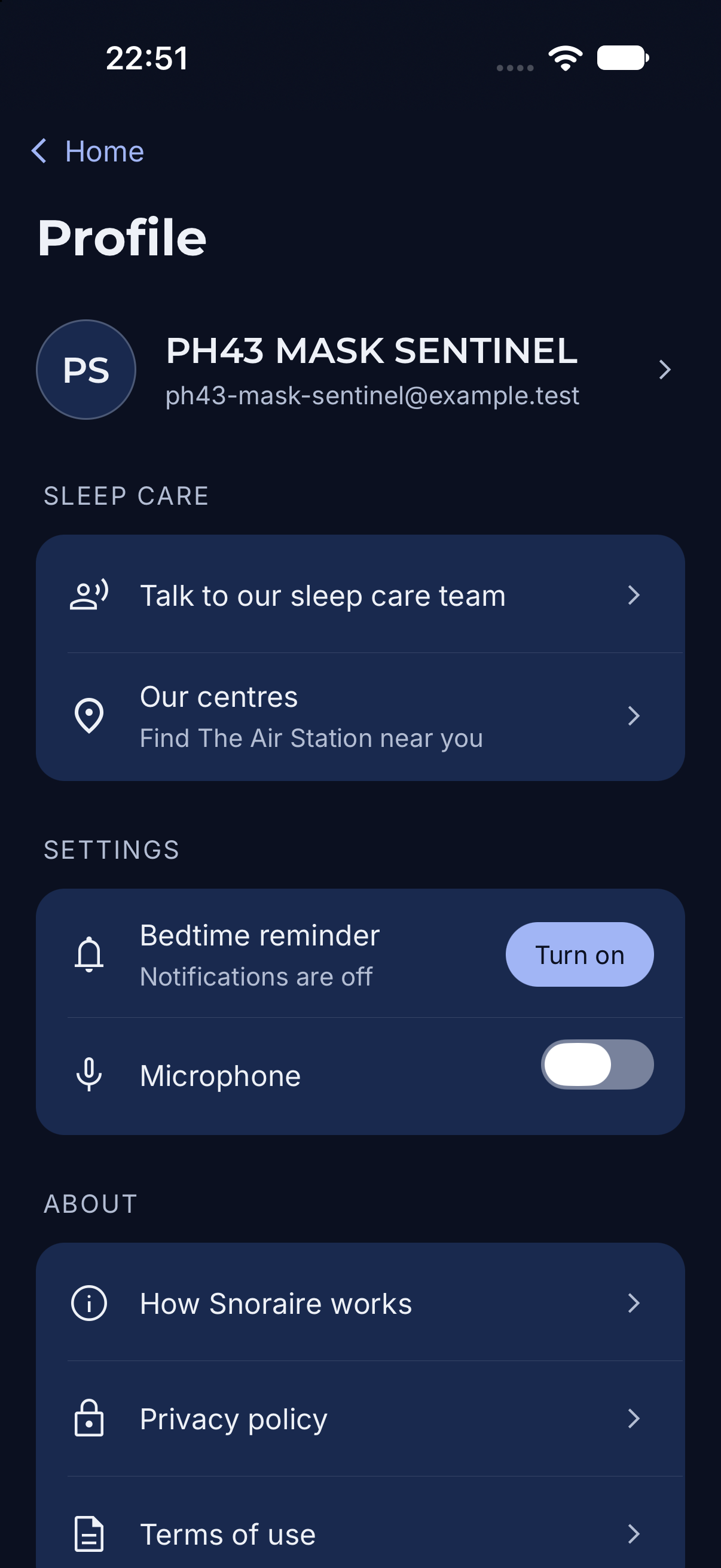
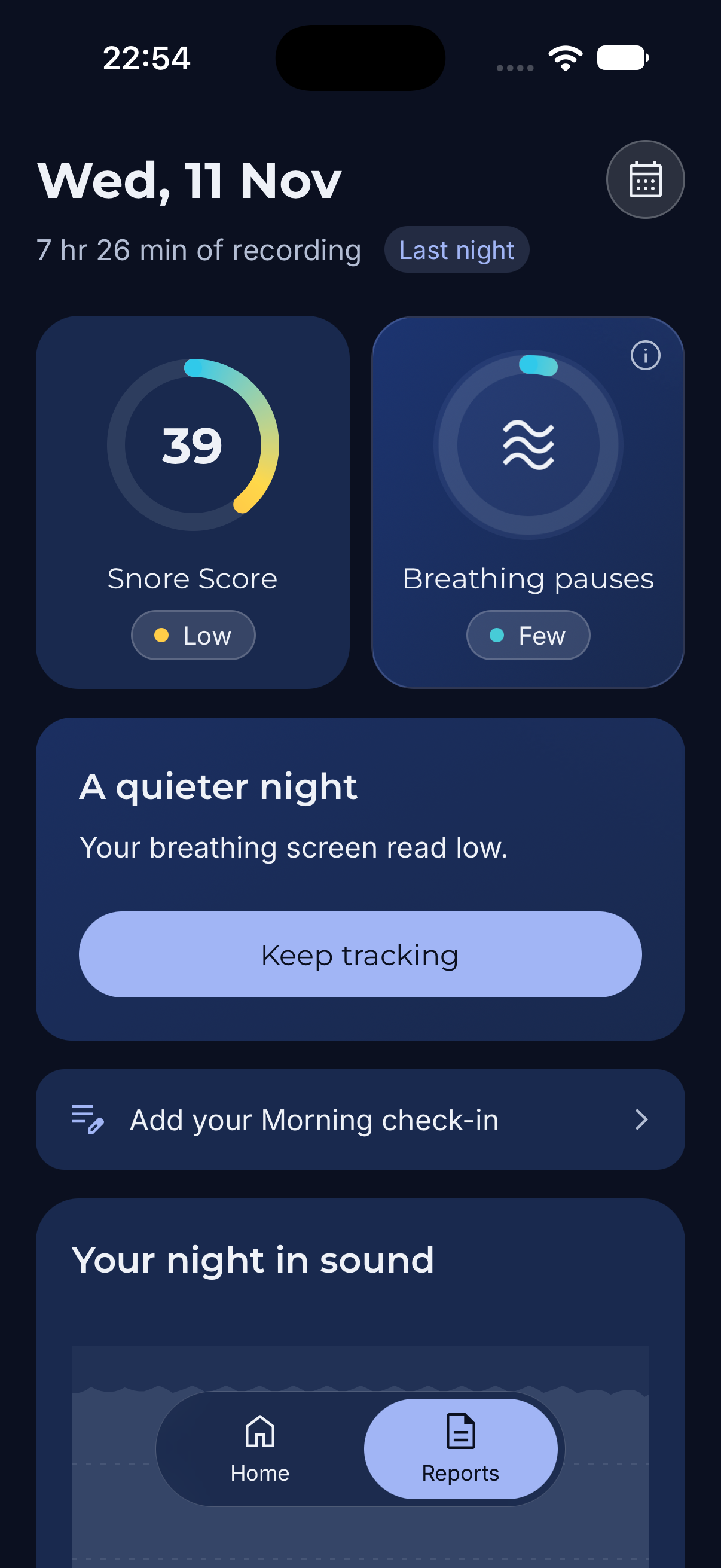
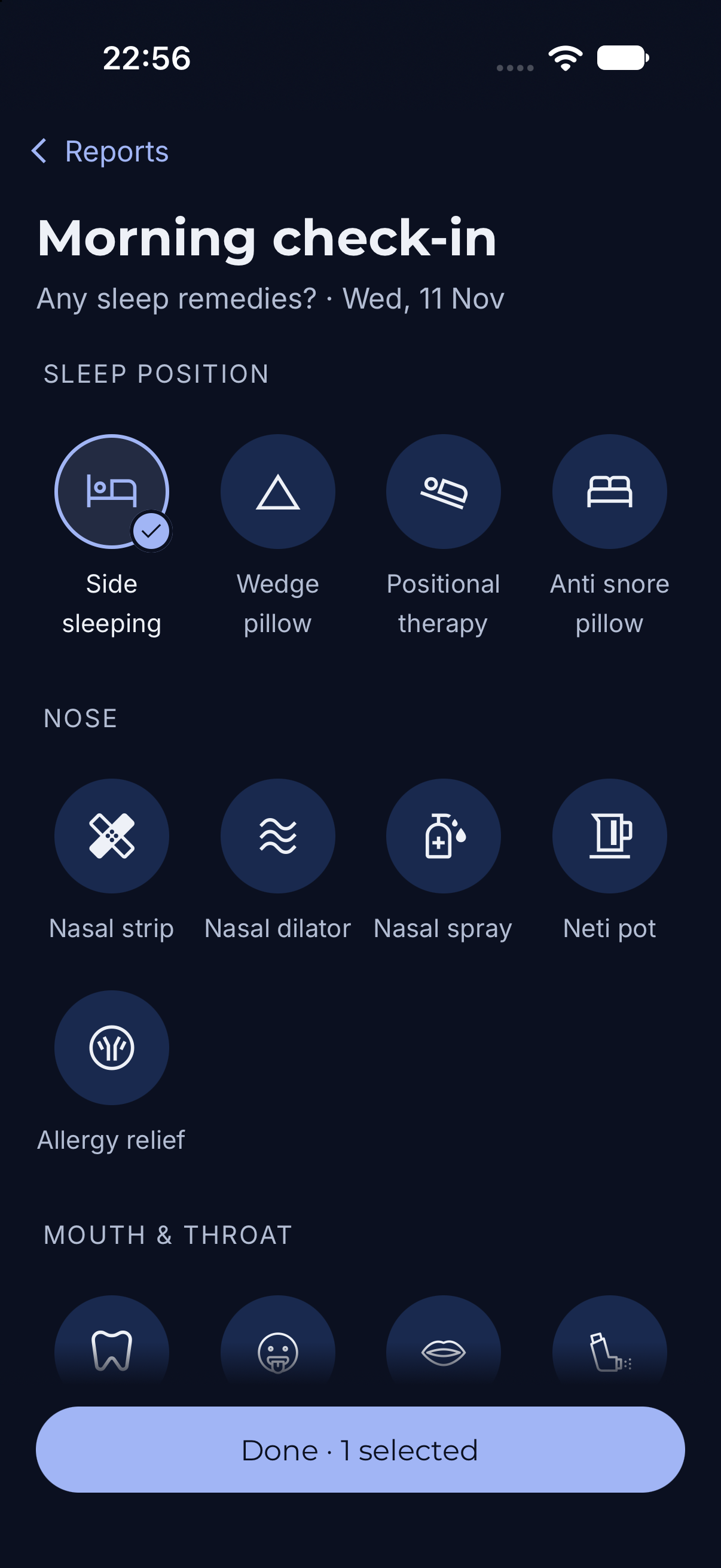
These are actual simulator screenshots with synthetic account and report data, not production-user content. They show what the app displayed; the linked provider frames establish what the recording concealed.
| App evidence | Provider evidence and limit |
|---|---|
| Profile screenshot | First recording, 03:36: identity region black-masked. Static labels also masked. |
| Reports screenshot | Second recording, 00:15: report content masked. App fixture showed score 39, Low/Few, Wed 11 Nov and 7 hr 26 min; these were unreadable in the inspected provider frame. |
| Check-in selection screenshot | Second recording, 01:59: masked prior frame consistent with NightNotes being intentionally excluded. check_in_saved was received; exact replay-stop timing remains unverified. |
Flows and recording diagrams
These nine diagrams match PR #43. They show the instrumented journeys and collection rules, not proof that every flow has passed a native test. Events record actions and outcomes, not audio, health values or check-in answers. NightNotes is excluded from replay; its save event contains no answer.
On a narrow screen, scroll each diagram sideways or open the full-size image.
Acquisition and account setup
Open full-size diagram · Diagram source
Onboarding and permissions
Open full-size diagram · Diagram source
Recording and processing
Open full-size diagram · Diagram source
Report and understanding
Open full-size diagram · Diagram source
Check-in and reminders
Open full-size diagram · Diagram source
Care and callback request
Open full-size diagram · Diagram source
Navigation across flows
Open full-size diagram · Diagram source
What data we record
Open full-size diagram · Diagram source
When collection runs or stops
Open full-size diagram · Diagram source
Earlier component screenshots
These three 390 × 1000 React Native Web previews use synthetic data and source from d5469117. They demonstrate component layout and working controls with external requests blocked. They are not native app or captured replay screenshots. The actual native screenshots and provider comparisons appear above.
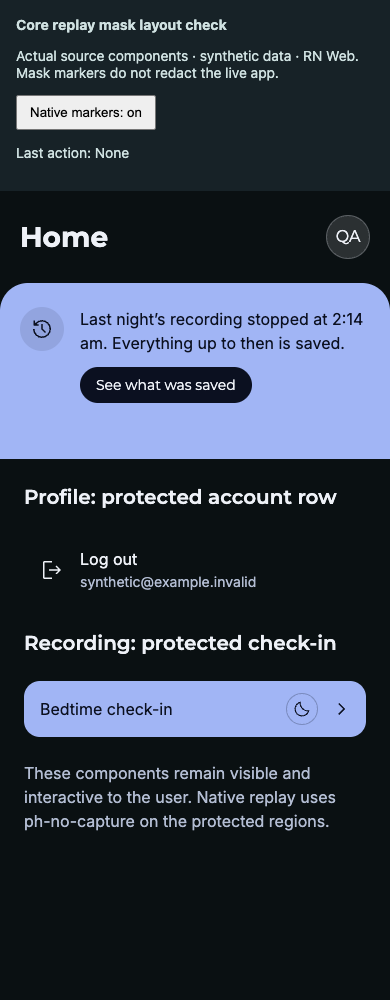
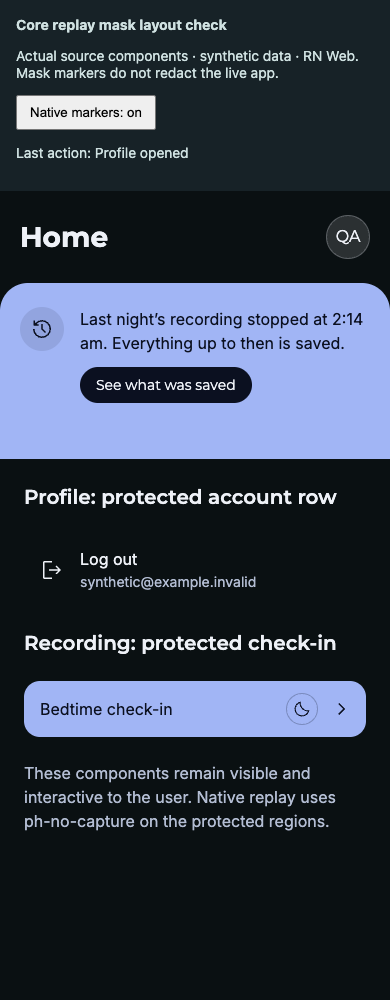
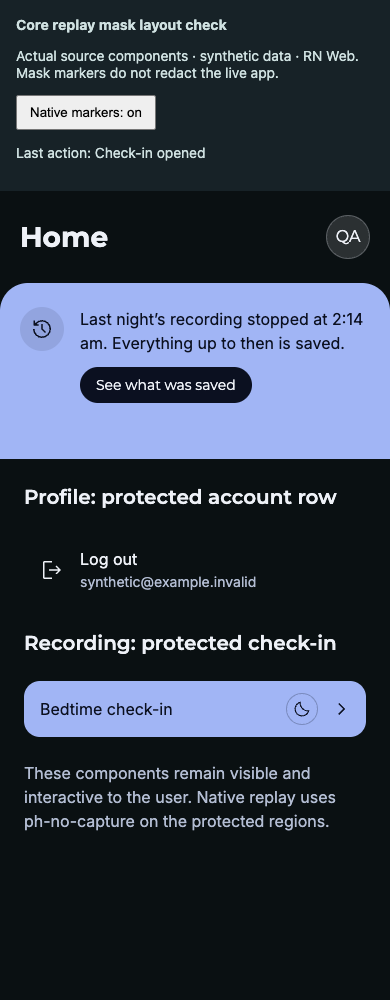
Captured replay frames were inspected in PostHog, but image export did not complete. Use the recording links and timestamps above to inspect those frames; these app and component images are not substitutes for replay images.
Historical research and checkpoints: 3 to 6 November 2026
The 12 November coverage review supersedes conflicting defaults, event counts, branch status and dashboard claims in this archive. Proposed hypotheses still need agreed definitions and evidence.
Replay and attribution are in draft PR #43
Version 2026-11-06-replay-attribution-pr-v1. Draft PR #43 targets develop at a4aa5009. PR #42 has merged. The new branch passed 12 checks, five build targets and six disposable PostgreSQL cases. Current-head GitHub readback found no configured feature-branch CI result. Marketing's Fathom/landing-page integration is deferred; no deployment or installed-device/provider acceptance is claimed.
Historical acquisition implementation checkpoint
Version 2026-11-06-acquisition-v1. The current worktree adds a Fathom download-button adapter, one-claimant campaign tokens, Android install-referrer claims, explicit iOS continuation and a backend-issued account analytics UUID. The contract now has 32 events. First-open observations are conditional on optional collection; they are not store download counts.
All 12 checks and five build targets pass. Six additional PostgreSQL cases cover the local HTTP handoff, claim races/retry/expiry, account ownership, first-touch preservation and deletion. These edits are uncommitted and not deployed. The real landing page, store URLs and iOS return behavior still need integration, followed by signed-device and provider receipt. Current scope, recipe and evidence.
Historical replay and device-metrics checkpoint
Version 2026-11-06-replay-device-v1. The current worktree adds consented, masked replay on guidance, permission, centre and legal screens, plus battery, charging, low-power, disk and memory samples. Delayed iOS MetricKit windows add CPU, memory and disk-write accounting when available. Recording samples reuse the existing pulse at a five-minute minimum interval. Earlier replay-off proposals below are historical.
The analytics setting now contains the switch and save-error feedback only. Earlier consent does not automatically authorize replay; a fresh choice is required. All 12 checks and five builds pass locally. These changes are uncommitted and not in the existing PR or a deployed native build. Native replay buffers may upload previously collected data after capture stops. Device masking, offline withdrawal and overnight overhead still need acceptance. Current scope and evidence.
Historical story-tracking implementation checkpoint
Version 2026-11-06-story-tracking-implementation-v1. The Snoraire worktree now integrates 28 client events into current upstream account, recording, report, playback, check-in, reminder and callback flows. The API separately emits a consented callback-acceptance outcome after its successful Zoho upsert. Usage is optional and off by default; account IDs, notes, ratings, audio and contact values are excluded from product events.
These are uncommitted source changes, not live beta reporting. Server telemetry configuration, deployment and physical-device/provider receipt remain open. Reminder callbacks do not establish background delivery; playback does not establish comprehension. The saved dashboard remains unchanged. Current implementation, evidence and limits.
Verified 6 November: measurement remains incomplete
The proposal was sent; live reporting is still unverified. PostHog has seven saved tiles, including two drafts. The new schema-v1 tracking has no observed receipt in the rolling 30-day audit. The historical 24 recording starts and 20 stops are diagnostic counts, not a conversion rate. Five old onboarding completions also lack the new schema version.
Current upstream has a callback request path. Develop f0aaf328 (mobile 0.1.10) calls the backend callback endpoint. The placeholder below belongs to the older analytics working tree. The new 15-event contract is still local and needs integration into current upstream; CRM receipt and human follow-up remain unverified. Fresh local validation passed 12 checks and all five builds.
The freshness draft still covers 13 events, missing the two setup additions. No log alerts are configured; other alert settings and approved metric definitions are scope-limited. No physical phones are attached. Notion access works, and this checkpoint is reconciled with EAS-4, EAS-35, EAS-110 and EAS-111. Definitions, targets, windows and candidate/device receipt remain open.
Checkpoint 2026-11-06-metrics-verification-v1. Current evidence, owners and next steps. Older sections below retain their dated limits. This local page has not been published.
Historical coverage: 5 November
We do not yet have complete beta measurement. The current checkout passes its local checks, but the new behaviour events have not been verified in PostHog. The table covers the PRD success measures as well as behaviour, crashes and heatmaps.
Local validation passed: 12 workspace checks, builds for all five projects and 17 focused onboarding/permission/contract tests. Device and provider acceptance remain open.
Review all product measures ↓ · Open PostHog dashboard →
The wizard dashboard has seven saved tiles, including draft stop-reason and event-freshness views. Both drafts show no matching candidate data. No new chart or alert was saved in this pass.
Checked 5 November 2026. Android reports no attached phone; CoreDevice cannot find the documented iPhone target. At that checkpoint Notion required reconnection. The 6 November checkpoint above supersedes this access limitation.
Do we have every product metric?
The PRD defines the intended success measures. This table separates those definitions from local instrumentation and observed data. We still need to agree targets, identifiers, denominators and observation windows.
| Measure | Status | Evidence | Required next step |
|---|---|---|---|
| Setup to first recording | Local code; receipt pending | The optional contract now permits onboarding_completed and permission_result. Completion follows the saved first-run flag; permission outcomes use system readback after a request. No candidate receipt is verified. | Verify setup completion, granted/refused permission outcomes and first recording on the candidate. The historical verification-first funnel still needs revision. |
| Usable recording and report | Local code; receipt pending | Count-once start, stop, usable completion and matching report events are implemented locally. No new completion/report events were found in the last 30 days. | Verify attempt references, offline/restart deduplication and the existing two-hour eligibility rule on Android and iPhone. |
| Repeat recording | Definition pending | Starts can support repeat-use analysis, but installation/account continuity and the return window are unresolved. | Agree identity, full observation window and treatment of reinstalls before reporting a rate. |
| Screen paths and control usage | Local code; receipt pending | Static screen names and labelled actions are implemented. No $screen or ui_interacted receipt was found in the last 30 days. | Run scripted foreground, tab, sheet and return journeys; reconcile events with actual actions. |
| Report explanation and next step | Local code; receipt pending | Ready-report views, explanations and care-interest taps are implemented. Their new events have no observed receipt. | Verify visit references and eligible exposures. A care-interest tap does not establish a submitted request. |
| Result comprehension | Usability task required | The PRD proposes an unaided explanation task. Navigation events cannot measure understanding. | Agree the rubric, participants, reviewer and threshold; record task results alongside behavioural evidence. |
| Callback requests and care follow-through | Blocked by service path | The older analytics working tree has a placeholder. Current upstream has a backend request path; accepted-request telemetry, CRM receipt and first human response remain unverified. | Integrate current upstream callback handling with the approved event contract; verify request acceptance, CRM receipt and response using an opaque request reference. |
| Crashes and exceptions | Historical ingestion; crash test pending | PostHog received $exception, most recently 21 October UTC. The replacement iOS simulator binary has matching uploaded native symbol files. Controlled crash receipt remains unverified. | Prove JS/native crash receipt and readable stacks for the exact Android/iOS candidate; review the native privacy path. |
| Pipeline and recording reliability | Partial | Pipeline stage events/logs exist locally. Stop-reason and freshness draft views are saved; candidate events are absent. | Prove terminal failures, processing time and build/device breakdowns; agree denominators and alert owners. |
| Battery, memory and overnight termination | Device evidence required | Product events and crash capture do not establish battery drain, memory behaviour or OS termination rates. | Run the physical-phone overnight matrix with analytics off/on and record device/build measurements. |
| Native spatial heatmaps | Native builds passed; pilot pending | UXCam 6.0.25 is included in completed Android APK and iOS simulator builds. Collection is off; no live heatmap receipt is verified. | Configure the Easmed project and synthetic pilot build. Verify masking, coordinates, withdrawal and overnight overhead on physical phones before broadening beta coverage. |
Checkpoint 2026-11-05-analytics-coverage-v3. The approved metric catalog is unavailable to the current connector; no rate in this review is presented as approved. Canonical plan and evidence.
Local implementation
Setup milestones were added on 5 November: first-run completion and explicit permission request outcomes. The permitted product event set now contains 15 names. The saved freshness chart still covers the earlier 13-event set and needs updating. Runtime receipt remains unverified.
Implementation is now in the working tree; device and provider acceptance remain open. Usage analytics is off by default, with the same optional choice before onboarding and in Profile. Declining continues onboarding; withdrawal clears local usage references and queued usage data. Existing crash diagnostics remain separate.
The code now has validated product properties, normalized screens and foreground visits, selected Home/Reports actions, shared recording outcomes, ready-report visits, and pipeline events plus structured logs correlated by an opaque attempt reference. Transport checks reject data from an earlier opt-in period, including buffered logs. The callback placeholder records interest only.
The UXCam pilot is integrated locally and disabled by default. PostHog touch capture, replay and native rage clicks remain disabled. No PostHog settings, saved insights or surveys were changed. Password authentication, account-lifecycle wiring, provider erasure and distributed API traces remain separate work. Native heatmap receipt and acceptance remain open.
Earlier local validation passed 12/12 checks, five build targets and 2,665 mobile tests. The current heatmap changes have a fresh 12/12 check pass; native builds and provider acceptance are tracked separately below. The installed-core transport probe passed six synthetic assertions; read the results. These checks do not establish native UI, offline delivery, masking or overnight acceptance. The canonical plan records the implementation and its limits.
Native heatmap pilot
The local integration uses UXCam 6.0.25. It needs a configured pilot build, a new native binary and a separate opt-in. Normal release profiles leave it off.
| Area | Current scope | Still required |
|---|---|---|
| Screen images and gestures | Welcome, the walkthrough and legal pages. Other scenes are masked, with gestures hidden. | Verify startup, transitions, sheets and errors with sensitive sentinels on both platforms. Home and Reports spatial coverage remains open. |
| Choice and withdrawal | A separate default-off switch in onboarding and Profile. The SDK starts only after opting in; withdrawal requests opt-out and pending-upload deletion. | Prove native withdrawal, offline/relaunch queues and provider deletion. A local preference does not establish provider erasure. |
| Provider and builds | The Android APK and replacement iOS simulator build finished. The iOS artifact includes the vendor API declarations and has matching uploaded native symbol files. Collection remains off. | Configure the Easmed project and privacy rules, then reconcile two scripted sessions per platform to heatmap points on physical phones. |
| Recording performance | PostHog keeps crash ownership. UXCam crash handling is disabled. | Compare capture off/on for memory, battery, network, interaction latency and a full eligible overnight recording. |
Heatmap collection has not been enabled. Completed internal artifacts: Android and replacement iOS simulator. These are not store distribution links. Physical-phone receipt, controlled crashes and overnight checks remain open. Notion requires reconnection, and the browser control host is unavailable, so dashboard and ticket updates remain pending. UXCam integration reference.
Historical PostHog audit: 3 November
The current coverage table above supersedes this dated snapshot. Historical counts remain here for reference.
Read-only MCP verified: shane.wong@easmed.com · Easmed / Snoraire 627573. Account/project reads, event aggregates and saved-funnel execution succeeded on 3 November. This replaces the earlier login-blocked status. No provider settings or saved objects were changed.
Window: 4 October 00:00 UTC to 3 November 09:45 UTC; final day partial, internal/test traffic included. These are diagnostic counts, not approved metrics. Read aggregate query evidence or the full audit and implementation plan.
| Area | Observed or configured | Meaning |
|---|---|---|
| Events | 24 recording starts, 20 stops, 147 opens, 64 exceptions. Seven-day counts: 10 starts / 10 stops / 35 opens. | No screen, touch, usable-completion, report-view or accepted-callback events observed. Start/stop totals are not completion conversion. |
| Builds | 763 events: 761 native SDK 4.78.2 events, two synthetic probes. Versions 0.1.8/0.1.9; Android/iOS; 208 emulator events. | All native events lack explicit environment tags. Physical-device traffic does not prove production or external beta use. |
| Identity | 12 identify events; starts split 19 anonymous / 5 identified. | Historical sign-in builds differ from the inspected anonymous source. Approved D-01 now requires password sign-in; accountless and older OTP plans are superseded. Analytics identity and reset policy still need agreement. |
| Dashboards and funnels | Two dashboards, 13 saved insights, no active notebooks. Existing onboarding funnel: 3 entrants → 0 at verification → 0 later steps. Web starter funnel returned no results. | Reuse the wizard dashboard. Correct its strict historical sign-in/verification order before interpreting drop-off. The metric catalog is empty. |
| Replay and heatmaps | Project toggles on; replay retention 30 days; zero retrievable recordings in the audited window. | Native replay, masking, entitlement and aggregate heatmaps remain unverified. Project toggles do not establish native SDK capture; retention limits historical conclusions. |
| Privacy and quality | IP/GeoIP property keys exist; no ingestion warnings returned. No raw health/contact values or replay frames requested. | Review SDK and server enrichment alongside the outbound allowlist. No warnings does not prove complete or minimized data. |
Smallest complete next step: retain the SDK; implement the approved identity transitions, collection controls, event validation, normalized screens, selected controls and reliable recording/report outcomes; add environment/build tags; then verify device actions against provider receipt. Keep broad touch capture, experiments and replay out of that first implementation. Run the native heatmap pilot separately with synthetic data.
Scope gaps prevent verifying heatmap objects, cohort membership, experiment/flag settings and billing entitlement. EAS-35/EAS-4 are now reconciled with the local plan; EAS-110/EAS-111 carry the matching setup review.
Two connected needs
Test a hypothesis
Start with a prediction, define the evidence and decision rule, then measure it. Record what the evidence supports, what it challenges and what remains inconclusive.
Discover behaviour we did not anticipate
Explore screen paths, control usage and repeated actions. Use funnels for a defined journey, and aggregate heatmaps to see where people interact on a screen. A session replay helps investigate an individual case; it does not replace an aggregate heatmap.
Interviews and surveys can explain why something happened. They support this work, especially when the question is about understanding rather than a measurable action.
Beta hypotheses
Review the selected evidence and product decisions in Beta hypotheses and results. Confirm the targets and minimum evidence before evaluating feature changes.
| Hypothesis | Evidence and measure | Limits |
|---|---|---|
| H01 · Preparation Clearer preparation guidance improves successful first use. | Track actual guidance exposure, recording starts/failures and usable completion. Proposed primary measure: eligible exposed installations producing a usable report within 24 hours. Also show start → usable completion separately. | Establish a baseline and comparison. Device failures and cohort differences can affect the result. The 24-hour window is proposed. |
| H02 · Report navigation Clearer navigation helps people find the explanation and next step. | Ready-report visit → explanation opened → next-step action. Use eligible visits as the denominator, or distinct installations for an installation-level measure. | Opening an explanation does not establish comprehension. Add a comprehension task if that is the claim we want to test. |
| H03 · Care expectations Clearer expectations help people reach the care team. | Separate care interest, app acknowledgement, server acceptance, regional Zoho receipt and human follow-up. | Check regional delivery and response with care operations. |
| H04 · Repeat nights People who need more context have a reason to record again. | Count opted-in identities with a first usable report in the selected date range and a full 72 hours of follow-up. Count a return when a recording started on a later Singapore calendar date produces a usable report within those 72 hours in the same consent period. | The first report is the earliest observed on the selected verified builds. Ask testers why they returned or stopped. |
What every hypothesis records
Stable ID, source need, prediction, owner, eligible audience, change/exposure, metric and denominator, observation window, decision rule, guardrails, PostHog insight links, findings and limitations, reviewer/date, decision and affected ticket.
States: Proposed → Ready → Running → Supported / Not supported / Inconclusive → Decision recorded. A supported hypothesis is not automatically approved scope. Before/after comparisons show association; they do not establish causation.
What the tools can show
| Need | Approach | Current position |
|---|---|---|
| Screen flows | PostHog screen events and User Paths. | Use normalized screen names and one Expo Router tracker. Paths explore transitions; funnels measure a specified sequence. |
| Taps and control usage | Explicit actions for important controls; restricted touch capture if broader exploration is needed. | Default touch capture includes visible text. Static identifiers and an outbound allowlist are required before expanding collection. |
| Conversion and drop-off | PostHog funnels, trends and defined outcomes. | A tap, a usable report and an accepted care request are different events. Show counts and denominators beside rates. |
| Individual sessions | Mobile session replay. | PostHog React Native replay uses screenshots. Exact-build masking and permitted collection need verification. |
| Aggregate spatial heatmaps | Pilot UXCam first; LogRocket is the fallback. | PostHog's documented heatmaps use web URLs and DOM elements. Native aggregate heatmaps are not established. Tap-count charts are an interim view, not a spatial map. |
Why these heatmap candidates?
UXCam documents React Native heatmaps, explicit screen tagging, Expo native builds and view-level masking. It is the first pilot candidate; compatibility with Snoraire's exact build is untested.
LogRocket documents Android/iOS heatmaps, including React Native. Use it as a fallback if the UXCam pilot fails.
Vexo documents aggregate heatmaps, but its privacy documentation says there is currently no individual-view masking/exclusion API. We would not select it first for sensitive Snoraire screens.
This is a researched shortlist, not a tested vendor ranking. We need to confirm entitlement/cost, retention, deletion, access and region before collecting pilot data. Run only one replay recorder at a time.
Implementation sequence
- Agree the measurement contract
Confirm the engineering owner, permitted identity/correlation, properties, collection controls and retention. Product owns the hypothesis decisions; Kedar reviews UX interpretation. Reuse existing PostHog metrics and insights where they match.
The inspected source stays anonymous, while D-01 confirms password-based sign-in. Implement the approved account journey and permitted analytics linkage/reset policy before calling installation counts “users” or linking activity across devices.
- Add screens, controls and reliable outcomes
Reuse the current PostHog setup and credential scrubber. Add one normalized screen tracker and a small, validated product-event contract. Keep labels static; exclude raw route parameters, contact data, health results, notes, audio and filenames.
Emit usable completion once per eligible recording across retry, restart and recomputation. Use durable state and metric deduplication where necessary. Analytics failure must not change recording or analysis success.
- Create the hypothesis register and dashboard
Reuse the existing wizard dashboard after correcting its definitions, and add a linked notebook per active hypothesis once instrumentation is verified. Include paths, the recording funnel, control counts, failures and time/drop-off between outcomes. Separate test traffic and incompatible builds. Add retention only after identifier continuity and return windows are agreed.
- Pilot native aggregate heatmaps
Use synthetic data, three safe screens and known gestures on both platforms. Two scripted sessions must produce the expected aggregate points/counts on the correct layout. Check scrolling, sheets, blank-space taps, safe areas and custom/native controls.
Test source payloads and screenshots for sensitive sentinels. Compare capture off/on for interaction latency, memory, network use and recording success. Include a full eligible overnight recording with the screen locked on each platform.
- Verify the signed candidate before beta rollout
Reconcile device actions to provider events. Check offline/reconnect, kill/restart, duplicates, withdrawal, erasure and upgrade. Verify the disable path while capture is running and after restart. Release only to the agreed cohort after the relevant reviews and device evidence.
Proposed event dictionary
These names describe local instrumentation and proposed service outcomes. Device receipt remains open. Keep existing recording event names and avoid duplicate emission.
| Event | Meaning |
|---|---|
$screen | A permitted normalized screen becomes visible in the foreground, once per transition. |
guidance_viewed | Preparation guidance is actually visible. Variant assignment alone is not exposure. |
onboarding_completed | The first-run flag is saved. Repeated completion callbacks and demo walkthroughs do not emit another completion. |
permission_result | Successful system readback after a microphone or notification request, including refusal. Uses fixed kind/status labels; excludes foreground refreshes and failed reads. |
ui_interacted | An approved action runs, with static screen, element and action identifiers. Sheets can be identified separately. |
recording_started | The controller successfully starts. This event already exists. |
recording_start_failed | A start fails, with a fixed reason category rather than raw error text. |
recording_stopped | A terminal stop occurs. Extend the current user-stop path to cover automatic/fault stops truthfully. |
usable_recording_completed | Existing eligibility rules pass and a usable report is persisted, once per recording. Preserve the under-two-hour discard rule. |
report_viewed | A ready report is foreground-visible. An empty Reports screen does not qualify. |
care_cta_tapped | Care interest only. It does not establish an accepted request. |
callback_request_accepted | A future service persists and acknowledges a validated request. Server-owned and blocked by the current placeholder. |
For tap rates, measure eligible screen/control exposure as the denominator. Without exposure data, label the view tap counts. Recording-level conversion needs an approved opaque attempt reference; keep actual recording IDs local. A local milestone marker alone cannot guarantee exactly-once provider delivery.
Earlier probe evidence: 3 November
The local checks test JavaScript behaviour, not a released analytics implementation. Passing probes include reproductions of capture limitations.
- 9/9 installed-SDK and scrubber probes passed. Synthetic React target fixtures invoked PostHog's actual touch-event builder with a capture spy. Tests reproduced default text capture, static-label restriction, capture-attribute bypass, dynamic-label content, ancestor exclusion, coordinates, missing-target omission, credential redaction and arbitrary sensitive fields surviving the current scrubber. Read the timestamped results and hashes.
- 1/1 existing scrubber unit test passed. This checks credential redaction. It does not test a new behavioural property allowlist.
- Source baseline checked. Local PostHog SDK 4.78.2 and native plugin 2.12.2; Expo 57.0.30, Expo Router 57.0.28 and React Native 0.86.3. Selected setup/source files matched upstream develop
fbdb124. These are not verified signed-build contents.
Open acceptance checks
- Live account/project, aggregates, catalog and saved funnels verified. New instrumentation still needs exact-build device emission and provider receipt.
- Native heatmap SDK compatibility, aggregate accuracy and useful masked backgrounds: no vendor pilot has run.
- Both-platform foreground gestures, offline/restart deduplication, withdrawal, erasure and upgrade: device evidence needed.
- Overnight performance and locked-screen recording with capture enabled: device evidence needed.
- Full application checks/build, fresh signed candidate and rollout: required during implementation.
PostHog's JavaScript output hook is not a complete control for native crash/replay paths. Inspect actual payloads and native masking separately. The local scrubber findings are synthetic; no live leak was observed.
Decisions and ticket alignment
EAS-35 lists Jonas as engineering delivery owner; EAS-4 lists Shane. We still need agreed identity and collection controls, hypothesis thresholds/windows, first heatmap screens, a selected vendor/plan, performance limits and the real callback-service contract.
EAS-35 · PostHog event allowlist and EAS-4 · collection policy were updated and read back under v4. EAS-35/EAS-4 remain In progress; EAS-110/EAS-111 remain Not started. Existing owners, dates and acceptance criteria were preserved. The portal is a local planning/evidence view; its updates do not automatically synchronize Notion or close tickets.
Version 2026-11-03-analytics-plan-v4. Matched to the canonical local implementation proposal of the same version. Findings remain distinct from approved scope, device acceptance and release approval.
Product documentation
- PostHog React Native: screens and touch capture
- User Paths · Funnels
- PostHog web heatmaps · Mobile replay
- UXCam integration · Aggregate heatmaps · Expo builds
- LogRocket mobile feature support · Vexo collection and masking limits
Checked 3 November 2026. Vendor documentation supports the shortlist; Airese device testing must establish actual compatibility.